Where Will the Snow Be in 2074?
The Opening Riff: Italy's €22 Million Snow Job
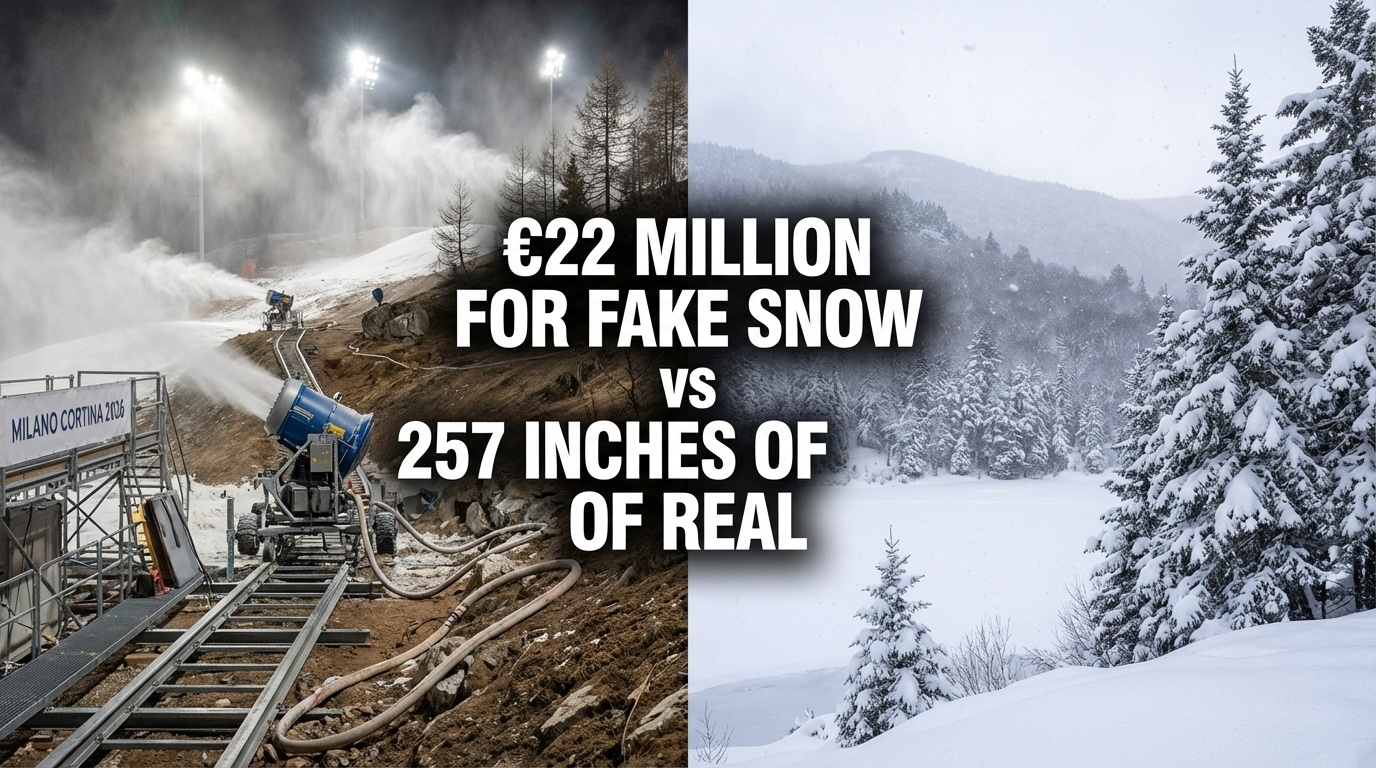
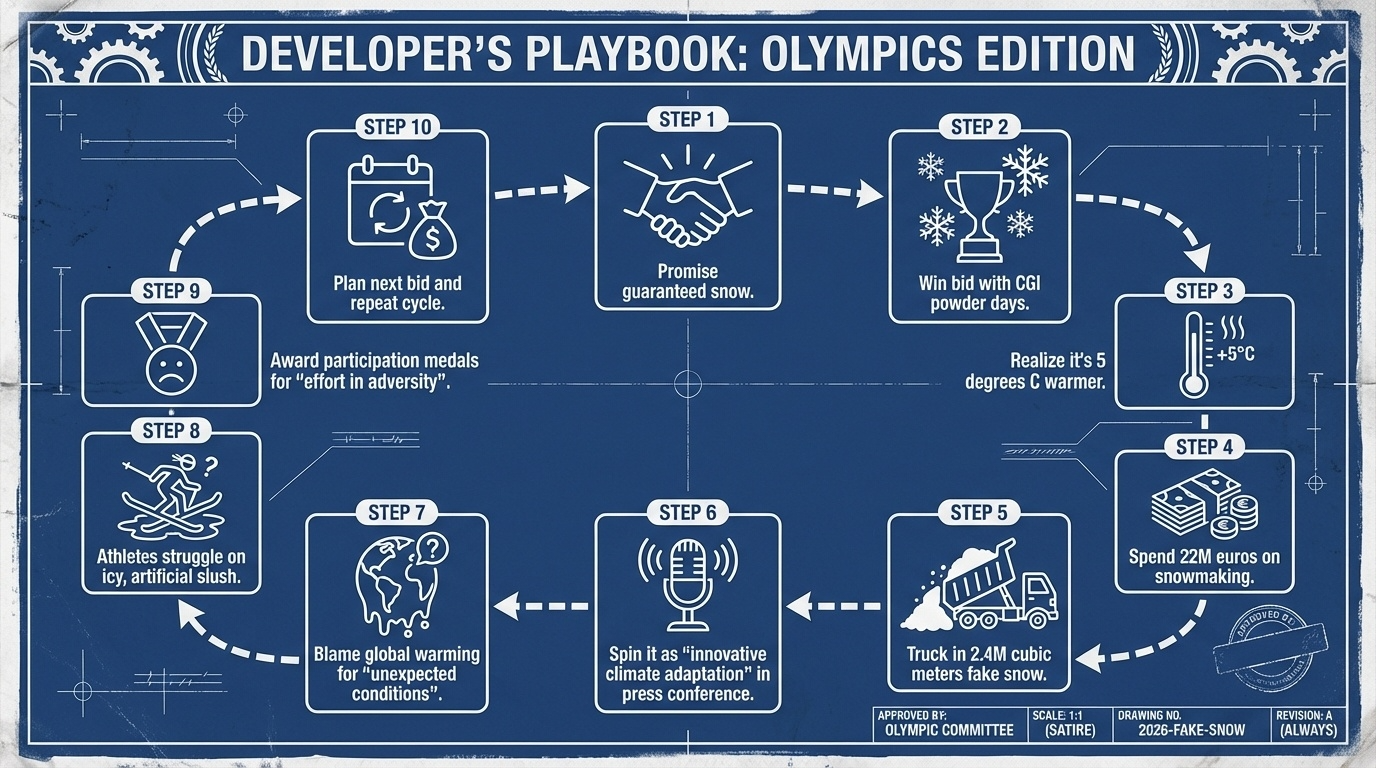
The 2026 Winter Olympics in Milano-Cortina opened with a spectacle the world hasn't quite seen before: 2.4 million cubic meters of artificial snow—enough to cover 960 football fields three feet deep—manufactured using 250 million gallons of water. That's the daily drinking supply for 900 million people.
The equipment cost? €22 million. The annual snowmaking budget for Italian Alps resorts? €50 to €100 million, representing 30 to 40 percent of their total energy costs.
Let that sink in. The birthplace of alpine skiing—the Dolomites, Cortina d'Ampezzo, the Italian Alps—cannot host the Winter Olympics without industrial fake snow.
Meanwhile, Cortina property values climbed 10 percent annually in the run-up to the Games, according to the Knight Frank Alpine Report. Those gains came with hidden infrastructure: €50 million in annual snowmaking costs just to keep the slopes white. By 2050, when temperatures rise another 2°C and the snow stops falling even with €100 million budgets, what happens to those €2 million chalets?
The Olympics have become a snow casino. And the house always wins—until it doesn't.
Bring It Home: The US Snow Crisis Is Here
While Europe makes headlines, the American West is quietly unraveling.
Vail Resorts—the largest ski resort operator in North America—reported in January that snowfall in the Rockies was 60 percent below the 30-year average for November and December 2025. Vail Mountain recorded its worst snowpack in 47 years: just 4.4 inches of snow-water equivalent. Only 11 percent of terrain was open as of January 4, 2026. The company cut its 2026 earnings outlook and used the phrase "historically low early-season snowfall" three times in the press release.
Park City hit a 30-year record low for snowpack in January 2026.
Palisades Tahoe—after logging a record 723 inches in the 2022-23 season—is tracking 50 percent below normal for 2025-26.
Here's what five years of snowfall data looks like when you stop believing the marketing brochures:
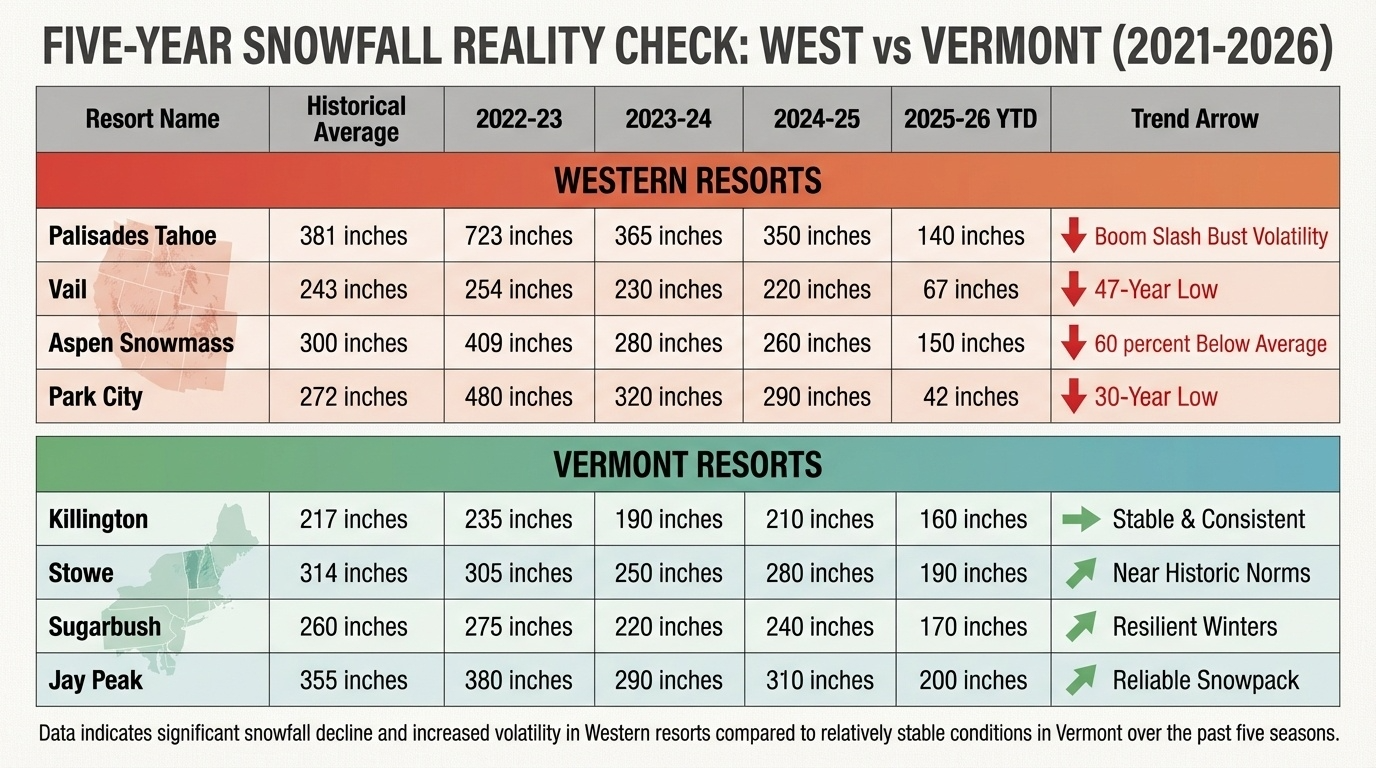
The pattern is clear. The West had one epic year in 2022-23—record-breaking snow that made everyone forget the drought years before it. Then two mediocre years. Then a crisis year in 2025-26.
Vermont? No boom. No bust. Just snow. Every 72 hours, like clockwork, driven by lake-effect systems off the Great Lakes that don't care about El Niño, La Niña, or shareholder earnings calls.
Jay Peak logged 257 inches by early February. Stowe has 218 inches. Killington is tracking toward ~320 inches for the season. Boring. Predictable. Bankable.
The 2074 Winter Olympics: Where Will They Be?
If current trends hold, the 2074 Winter Olympics will have exactly four options: Niseko (Japan), Terskol (Russia), Val d'Isère (France), and Courchevel (France).
Notice what's missing? The entire United States.
Not Vail. Not Aspen. Not Park City. Not Jackson Hole. None of them will have reliable natural snow by mid-century, according to projections from Climate Central and a 2024 study published in Nature Climate Change.
Of the 93 cities with Olympic-level winter sports infrastructure, 94 percent are "climate reliable" today. That number drops to 44 percent by the 2080s. The Rockies won't make the cut.
Vermont won't host the Olympics either—we don't have the infrastructure, the hotels, or the half-pipes. But we'll have something better: snow. And when you're a second-home buyer in 2026 looking at a 30-year hold, "boring and reliable" suddenly sounds like the best investment thesis on the mountain.
Follow the Money: The 30-Year Real Estate Math
Let's compare two buyers in 2026 making 30-year holds:
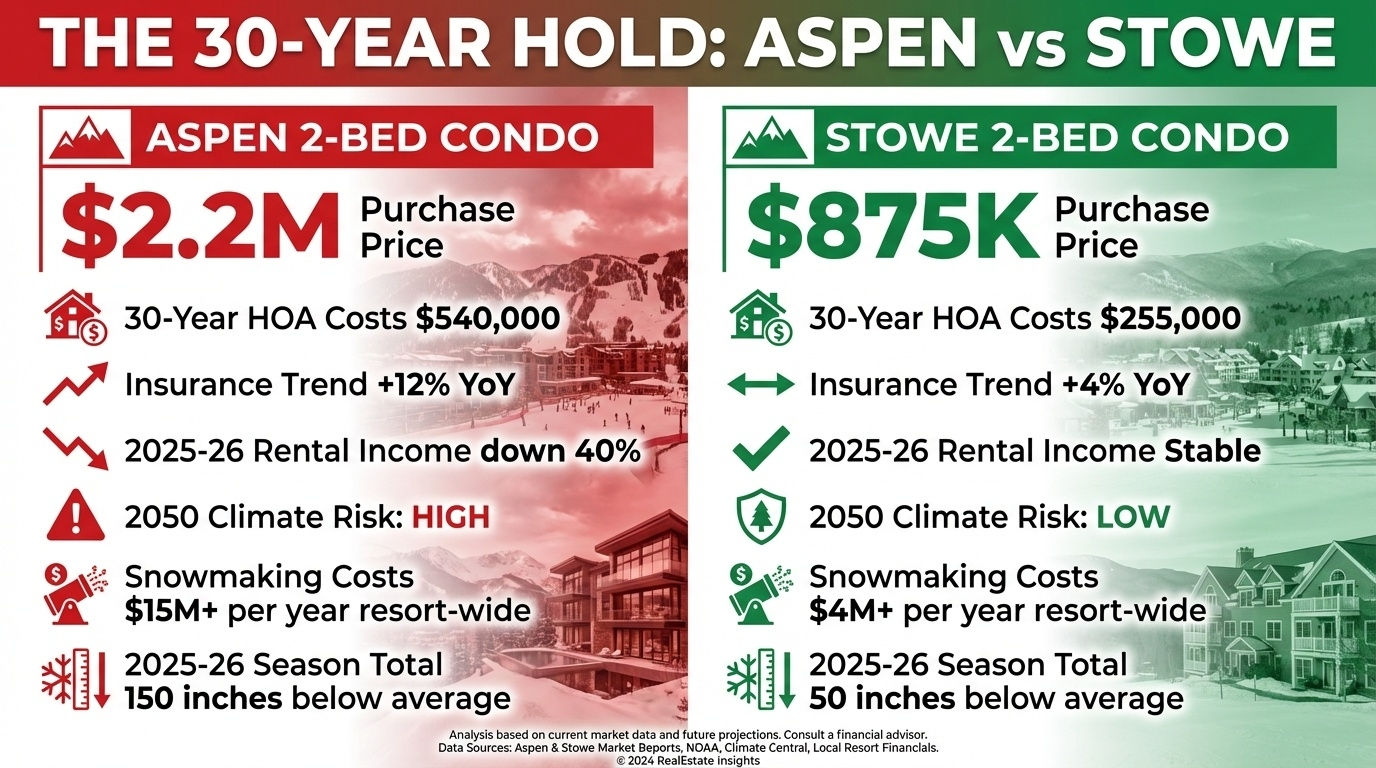
Buyer A: Aspen 2-Bed Condo
-
Purchase price: $2.2M
-
Annual HOA dues: $18,000 ($540,000 over 30 years)
-
Insurance premium trend: +12% YoY (climate risk)
-
Rental income (2025-26): Down 40% (shorter season, fewer bookings)
-
2050 resale risk: High (potential 30% depreciation if snowfall continues declining)
Buyer B: Stowe 2-Bed Condo
-
Purchase price: $875K
-
Annual HOA dues: $8,500 ($255,000 over 30 years)
-
Insurance premium trend: +4% YoY
-
Rental income (2025-26): Stable (218" season total, predictable bookings)
-
2050 resale risk: Low (climate models show Vermont stable through mid-century)
Net difference over 30 years:
-
Aspen: $1.325M more upfront + $285K more in HOA dues + unknown climate depreciation
-
Stowe: Lower entry, lower carry cost, climate hedge built in
Total savings: ~$1.6 million, plus you actually get to ski.
You're not buying Vermont because you can't afford Aspen. You're buying Vermont because Aspen won't have snow.
This Week's Tracks
🎸 Classic Rock & Fresh Powder Playlist (on Spotify)
- Public Enemy – "Don't Believe the Hype"
(Aspen marketing vs. 67 inches of snow) - Bob Dylan – "The Times They Are A-Changin'"
(Climate isn't negotiable) - Neil Young – "Mother Earth (Natural Anthem)"
(Lake-effect snow doesn't need a press release) - The Clash – "Should I Stay or Should I Go"
(Tahoe vs. Vermont) - R.E.M. – "It's the End of the World as We Know It (And I Feel Fine)"
(Vermont's fine)

:format(webp):quality(80)/u.realgeeks.media/rgtemplate/Market-Report-2.png)