By The Numbers Guy | February 5, 2026
Thirty-nine million U.S. homeowners still hold mortgage rates below 5%, and only 6% gave up those rates in 2025—but Vermont home prices rose 5.8% last year to a median of $385,000, meaning sellers sitting on low rates are also sitting on significant equity gains. If you're a Vermont homeowner weighing whether to sell now or wait for rates to drop further, the math suggests that waiting may cost you more than moving does.
If You Only Do 3 Things
- Calculate your equity gain: If you bought before 2022, your Vermont home likely appreciated 15–25% or more—run the numbers on what you'd net after sale.
- Model your next purchase payment at 6%: A 6% rate isn't 3%, but it's workable if your equity covers a larger down payment or the home you actually want.
- Get a professional market analysis: Early 2026 sellers have negotiating power before competition ramps up—but that advantage shrinks as more sellers test the market in March–April.

What Changed (and the One Number That Matters)
Let's run the numbers.
If you locked in a rate below 4% anytime between 2020 and early 2022, that rate feels like a golden handcuff. You're not wrong. Math doesn't care about feelings, but it does care about opportunity cost.
Here's what the data tells us: CNBC reported this week that roughly 39 million homeowners nationwide are sitting on rates below 5%. Another 12 million are below 3%. Last year, only about 6% of those folks sold or pulled cash out. Translation: 94% stayed put.
In Vermont, that same psychology is playing out—but with a wrinkle. While the rest of the country saw modest or flat appreciation, Vermont's median sale price hit approximately $385,000 by year-end 2025, up 5.8% from 2024. If you bought in Central Vermont in 2020 for $300,000, you're likely sitting on $385,000 to $400,000+ in value today. That's real money.
The Data (What the Numbers Actually Say)
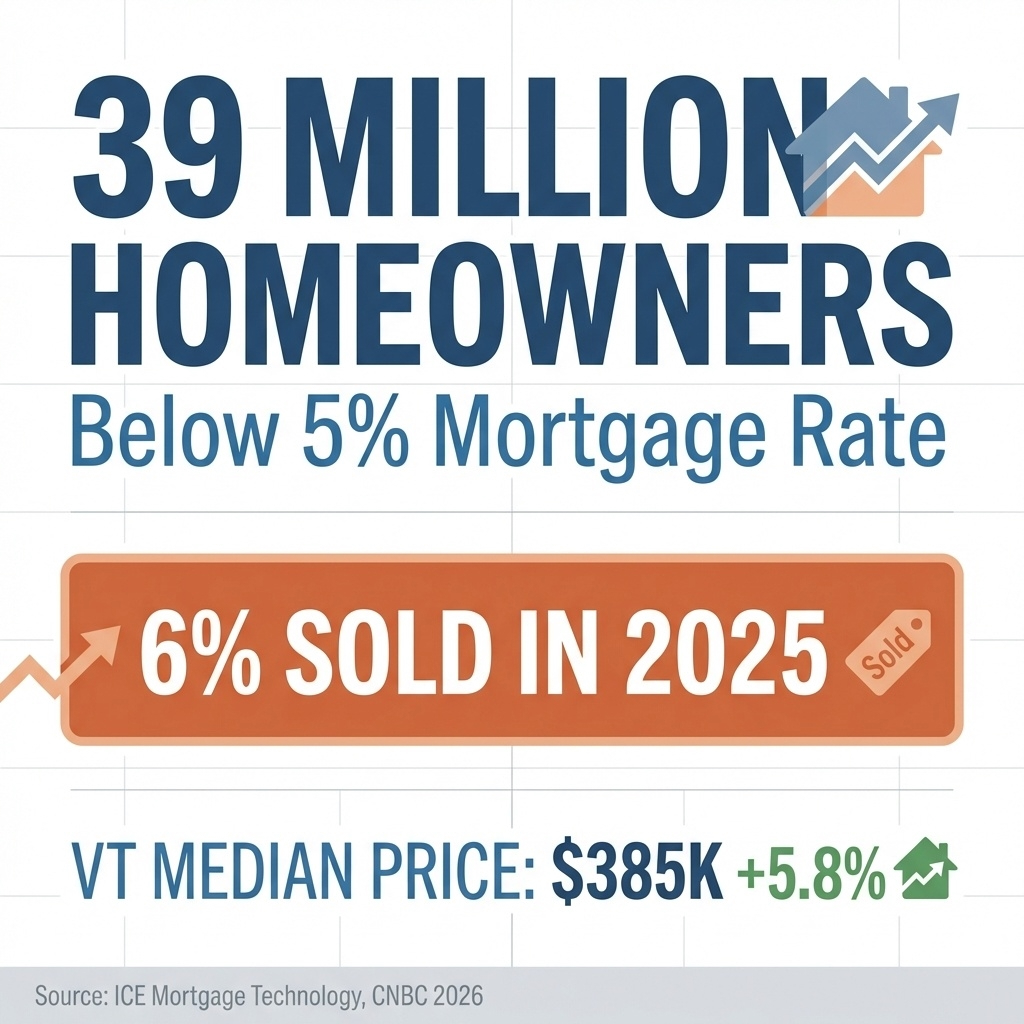
Here are the three numbers that matter:
1. Thirty-nine million homeowners hold rates below 5%. That's the national baseline. According to ICE Mortgage Technology and reported by CNBC on February 4, 2026, this cohort represents the vast majority of homeowners who refinanced or bought during the 2020–2021 rate environment. They're not moving unless forced.
2. Vermont's median sale price is approximately $385,000, up 5.8% year-over-year. That's from year-end 2025 data compiled by Vermont brokerages including Catalyst Realty. In Central Vermont specifically, some towns are seeing medians closer to $400,000 or higher. If you bought before the surge, you've captured that gain—but only on paper until you sell.
3. The current 30-year fixed mortgage rate is around 6.10%. As of late January 2026, Freddie Mac's Primary Mortgage Market Survey pegged the average 30-year fixed rate at 6.10%, down from over 7% a year ago. That's not 3.5%, but it's also not 8%. It's workable—especially if you're bringing $80,000 to $120,000 in equity to the table.
Translation: If you're sitting on a $300,000 home you bought in 2020 at 3.5%, your monthly principal and interest payment is roughly $1,347. If you sell that home today for $385,000, net $100,000 after costs, and buy a $450,000 home at 6% with 20% down ($90,000), your new payment is approximately $2,098. That's $751 more per month.
But here's the question nobody's asking: Is the $300,000 home still the home you want? Or are you staying because the rate feels too good to give up?
So What Does That Mean for Vermont?
Vermont operates on its own rhythm. Inventory traditionally drops in winter, then surges in March and April as sellers prep for the spring market. In 2025, inventory rose 11.7% by November—a sign that more homeowners were willing to test the waters. But sales velocity stayed slow. Why?
Because the buyers are also sellers. They're locked in at 3.5% or 4.25%, and they're doing the same math you are. The breakthrough happens when someone says, "I'm leaving money on the table by staying in a home I've outgrown."
Here's the Vermont-specific angle: If you list in February or early March 2026, you're ahead of the spring rush. Buyers who are serious right now aren't window-shopping—they're committed. You'll face less competition from other sellers, and you can price strategically without getting undercut by ten other listings in your zip code.
Wait until late April, and you're one of forty listings in a five-town radius. The advantage evaporates.
The other factor: Vermont's equity gains are sticking. Unlike some sunbelt markets where prices spiked then corrected, Vermont's appreciation has been steady and supported by real demand—remote workers, second-home buyers, and retirees who want land and access to outdoor life. That demand isn't reversing. Your equity is real.
Bottom Line (The Gain Frame)
That 3.5% rate isn't a golden ticket. It's a sunk cost.
If the home still works—if the bedrooms fit your family, if the commute makes sense, if the town is where you want to be—then by all means, hold the rate. But if you're staying because you can't stomach giving up 3.5%, you're making a $750-per-month decision that's costing you quality of life.
Here's the play if you're a Vermont seller:
Step 1: Calculate your net proceeds. Take your current estimated home value (use Zillow, Redfin, or get a professional comparative market analysis). Subtract 6–8% for closing costs and commission. That's your equity war chest.
Step 2: Model your next purchase at 6%. Find the home you want. Run the mortgage payment at 6.10% with your equity as the down payment. If the payment is workable, you've just bought permission to move.
Step 3: List before the spring surge. February and early March sellers in Central Vermont have leverage. Use it.
The math won't get dramatically better if you wait. Rates may drop another quarter-point by summer—maybe. But Vermont inventory will definitely rise, and your negotiating position will definitely weaken. The window is open now. It won't stay open.
What to Do Next
If you're a Vermont homeowner sitting on equity and a low rate, the first step is to stop guessing and start calculating. A professional comparative market analysis can show you what your home is worth today—not what Zillow thinks, but what buyers in your town are actually paying.
From there, model the next move. What does a 6% payment look like on the home you want? What's the monthly cost of staying versus moving? Most importantly: What's the cost of staying in a home that no longer fits?
The 39 million homeowners locked below 5% aren't all making the wrong choice. But some of them are staying for the wrong reasons. Don't be one of them.
Contact New England Landmark Realty:
Office: (802) 253-4711 or (866) 324-2427
Tony's Cell: (802) 233-4107
Website: www.nelandmark.com
Vermont Home Buying Guide | Selling Your Vermont Home
Where to Go Next
Sources
- CNBC: "Homeowner mortgage rates: Here's the breakdown of U.S. borrowers" (February 4, 2026)
- Freddie Mac Primary Mortgage Market Survey (January 29, 2026)
- Catalyst Realty Collaborative: Vermont Real Estate Market Update (January 2026)
- New England Landmark Realty: Vermont Home Prices + Inventory Analysis (January 2026)

:format(webp):quality(80)/u.realgeeks.media/rgtemplate/Market-Report-2.png)