New England Landmark Realty | Kore’s Design Eye | Vermont Real Estate Staging & Design Strategy | Spring 2026
Key Takeaways — If You Only Read This Far
Two-sentence summary: Vermont sellers have spent fifteen years apologizing for the most valuable design assets in their homes — wide pine floors, original millwork, braided rugs, and grandma’s quilt — by hiding them, but Pinterest now calls that a mistake and buyers already know it. This article shows Vermont sellers exactly which pieces to keep, which to edit, and the three things agents will flag before any listing goes live.
- 1. Stop hiding the character. Display the quilt, the braided rug, and the original millwork as features — they are what out-of-state buyers are paying $435,000 to find.
- 2. Edit, don’t erase. Remove worn or smelly pieces; keep anything with warmth, pattern, and story. A $30 thrift-store quilt can stop a scroll.
- 3. Know the three things agents hate before listing: imperfect wallpaper, heavy drapes that block winter light, and worn or fraying textiles. Fix those. Keep everything else.
Kore’s Take: Pinterest Just Corrected Eight Years of Bad Advice
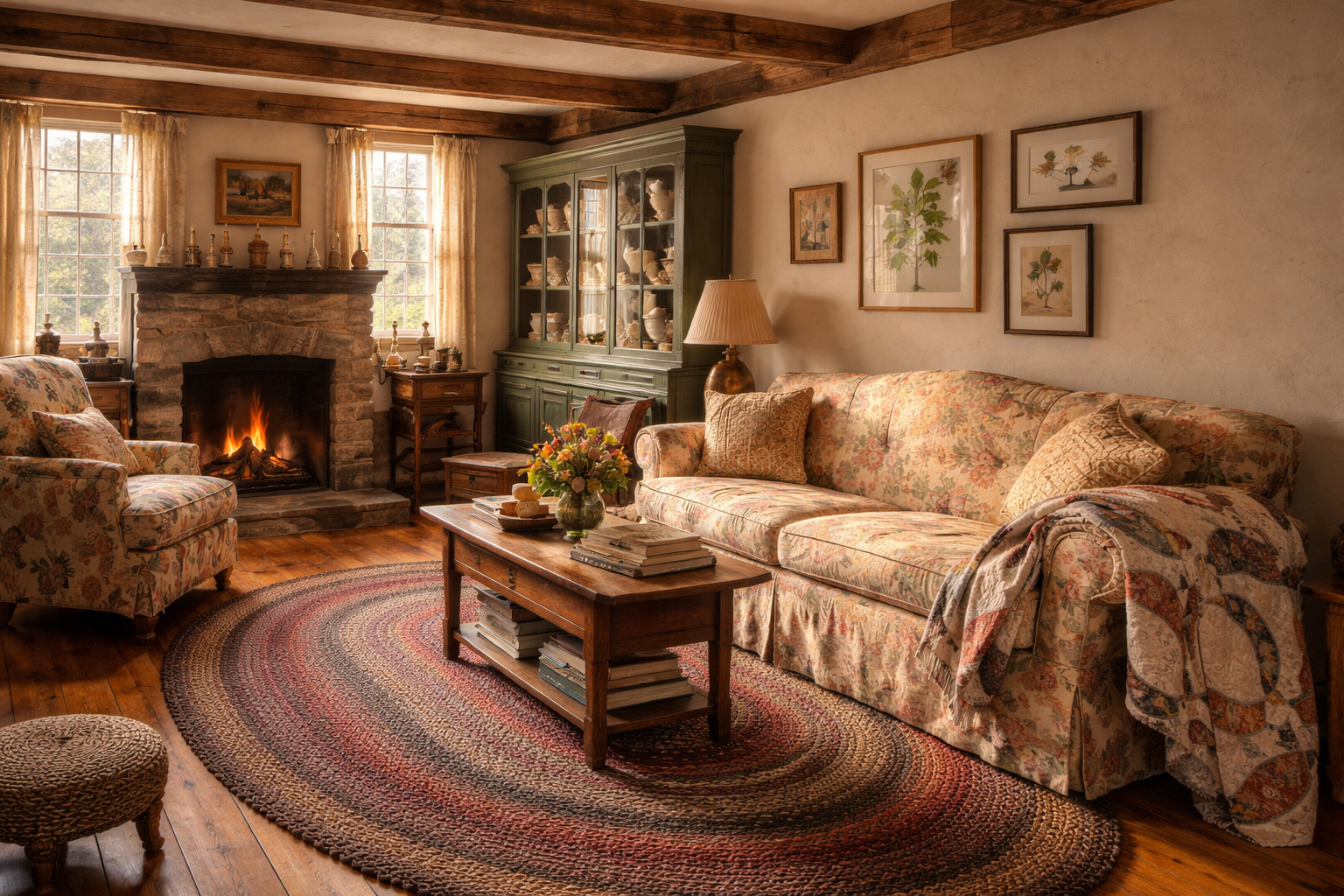
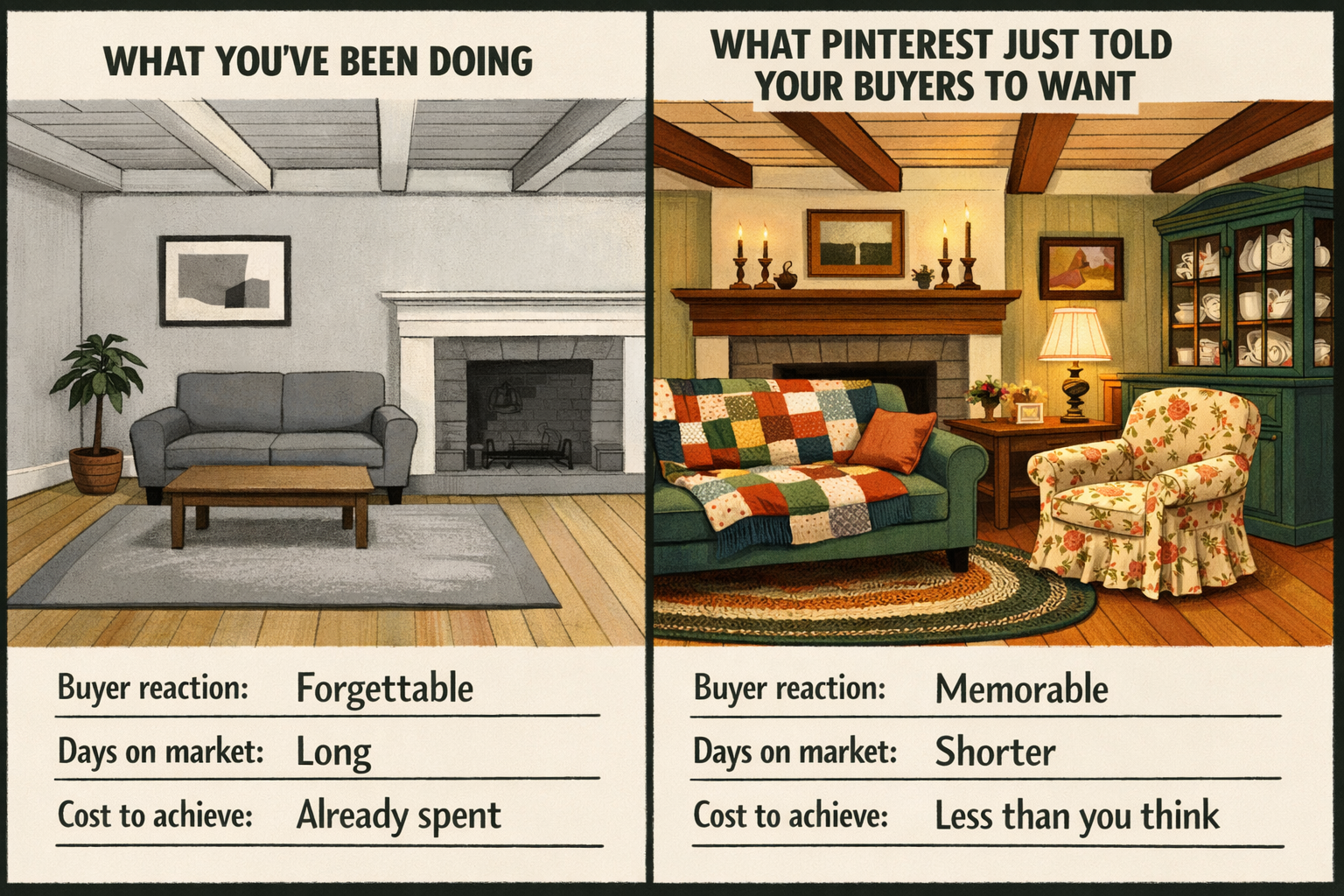
I walk into Vermont listings every spring and I see the same thing. Painted beams. Grey jute rug over perfectly gorgeous pine. White linen pillow on a white sofa. One sad succulent on the mantel.
And I think: who told you to do this?
Here is what actually happened. You had a braided rug. Probably your mother’s, or something you found at a barn sale for thirty dollars. An armchair with a wild floral print. Maybe a quilt on the back of the sofa. And somebody — a well-meaning friend, a staging blog, a Pinterest board from 2017 — told you it looked “too old.” So you hid it. Donated it. Replaced it with the staging equivalent of a beige hotel room.
That braided rug now sells for $400 on Chairish. The grey jute communicates nothing except that you were nervous. And the buyer scrolling Zillow at 11pm from a Boston apartment? They are not looking for a blank canvas. They can build a blank canvas anywhere. They came to Vermont for the opposite of that. They came for the room their grandmother had — made warmer, made intentional, made theirs.
Pinterest just said so, officially, with 80 million saves. Your farmhouse was built for this moment. Let’s stop apologizing for it.
The Quiet Problem: You Staged the Soul Out of Your House
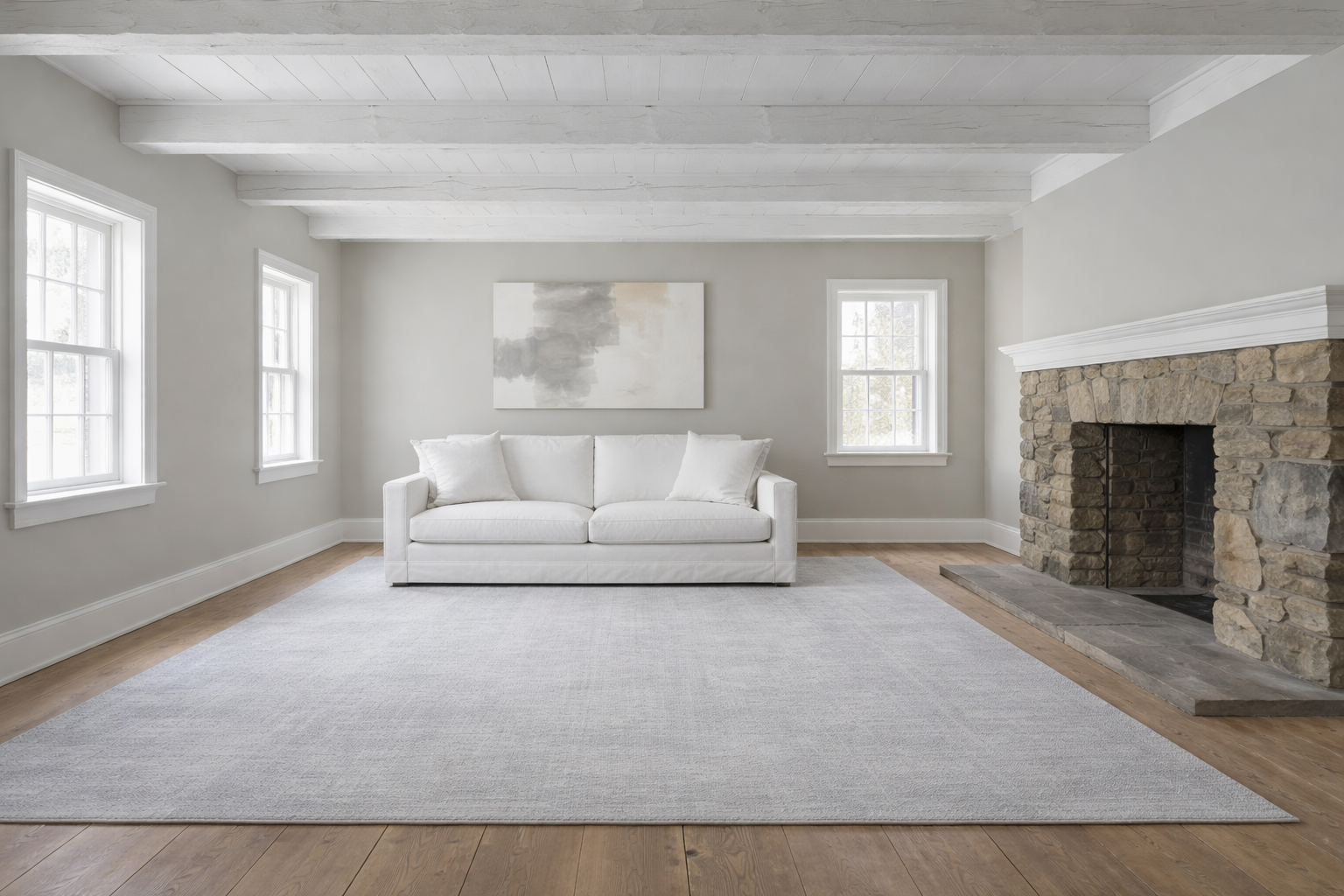
I call this look “the Airbnb apology.” Wide pine floors buried under a cool-grey rug. Hand-hewn beams — hand-hewn! — painted the same flat white as a box store. A slipcovered sofa. One abstract print above the mantel, greige on greige. The kind of room that photographs competently and makes buyers feel absolutely nothing.
Nothing is technically wrong with any of those choices in a different house. A new construction Colonial in Williston? Sure. Fine. But in a 180-year-old Vermont farmhouse, it communicates exactly one thing: we were embarrassed by what this place actually is.
Buyers feel that embarrassment. They don’t name it. They just click to the next listing.
Here is the irony. The grey jute rug, the white beams, the sad succulent — those are not free. You spent money to strip the character out of a house that buyers would have paid more for if you’d left it alone. The greige era was expensive. Grandma Chic costs almost nothing, because most of you already own it.
The Fix: What $200 and One Saturday Actually Buys You
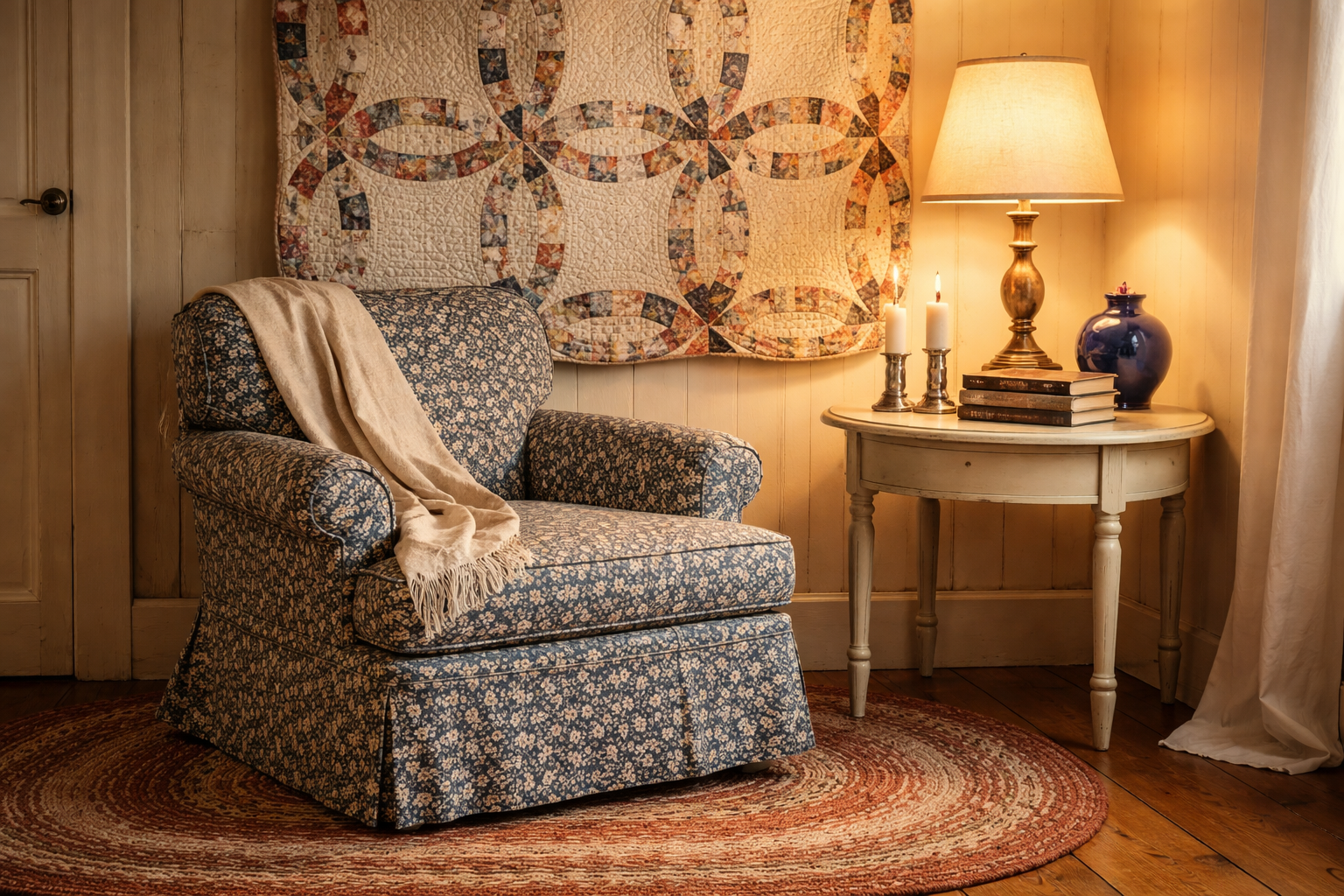
$0–$200 / One Saturday. Go to the attic first. Retrieve the braided rug, the quilt, the candlesticks, and whatever is in the box labeled “grandma’s china.” Put the rug down. Hang the quilt flat on the wall above the sofa — the patchwork geometry is more striking in a listing photo than anything you can buy new. Display the china. Beeswax the pine floors. Swap every overhead bulb to 2700K warm-white LED (the cool-blue ones are killing your photos). Open the curtains. That’s the whole job.
$200–$600 / Two weekends. Find one armchair at an estate sale or on Facebook Marketplace and reupholster it in a bold floral or stripe. A single statement piece changes the energy of a room. Add a brass or aged-bronze pendant where you currently have a builder-grade drum shade. A botanical print, framed simply, above the mantel. None of this is renovation. It is decision-making. That is what stagers get paid for — but you can do it yourself.
$600–$2,000 / Let a pro do it. If you want to hand it off entirely, call one of the Vermont stagers I mention below. They speak this language fluently and they know what photographs for Central Vermont buyers. Staged homes sell approximately 5–10% more and 73% faster, according to NAR and The Zebra (2025 data). Do the math on a $435,000 median price. That’s not a decorating budget. That is an investment return.
- Wallpaper: I love wallpaper. I will fight anyone who says it is “too much.” But if the seams are sloppy, the paper is bubbling, or the pattern is a dated border print from 1993, take it down. Wallpaper done wrong reads as deferred maintenance. Wallpaper done right reads as a designer’s decision. There is no middle ground in a listing photo.
- Heavy drapes: Vermont homes already fight for light from October through April. If your drapes are blocking the windows in your listing photos, you are actively working against yourself. Swap to light linen, sheer panels, or leave the windows completely bare if the trim is in good shape. Natural light is your best staging tool and it costs nothing.
- Worn or fraying textiles: A stained quilt is not character. A rug with a torn edge is not charm. Anything that looks tired, smells like storage, or has visible wear tells buyers to start wondering what else in the house has been neglected. Kate Ziegler, a Boston agent who deals in exactly this buyer demographic, put it bluntly: “If it’s not immaculate, it feels just old, and buyers get nervous about updates and systems behind the decor.” (via Apartment Therapy)
Vermont’s Secret Weapon: The Designers Who Were Already Here
Jen Novak — The Gilded Elephant (Charlotte, VT)
Houzz calls her practice “new traditional, transitional, eclectic.” I call it what it is: the exact aesthetic buyers are currently losing their minds over on Pinterest. Jen has been reinventing vintage pieces with bold color and pattern for years — custom upholstery, window treatments, serious vintage finds. She was doing Grandma Chic before it had a hashtag. Charlotte-based, serves Chittenden County and beyond.
Pam Carter & Chelsea Audy — Keeping Good Company (Vergennes, VT)
A mother-daughter team — which, yes, is exactly as charming as it sounds — specializing in Vermont second homes. They do furniture, custom rugs, full staging, and turn-key services for people buying Vermont properties remotely. Their Instagram is a tutorial in layered warmth done right. Vergennes-based, available across the state.
Elizabeth DeCecco — Corduroy + Pine Interiors (Williston, VT)
If you have a wallpaper project — and I think you might, after reading this — Elizabeth is who you call. Her signature is wallpaper done correctly: pattern with intention, scaled precisely, installed impeccably. That is the difference between “Grandma Chic” and “my grandmother’s bathroom in 1994.” Williston-based, full-service interior styling.
Janine Conti — Janine Home & Style (West Dover, VT)
Janine calls her work “Vermont rustic chic,” which is the closest existing label to what we are talking about here. She is a stager and stylist — she knows what sells in this market, which rooms photograph first, and which pieces need to go. If you are in the southern part of the state and you want a professional eye before your listing goes live, start here.
Hannah — @haninthecountryside (Vermont, 30K+ followers)
Not a stager — a real person living in a 184-year-old Vermont farmhouse who has accidentally created the most accurate visual representation of what your buyers are dreaming about. Wide pine floors. Quilts on everything. Objects with actual history. Open her feed and show your seller clients: this is what they are coming to Vermont to find. That is not a renovation project. That is already your house. Stop hiding it.
The Lineup: Grandma Chic vs. Modern Farmhouse vs. Modern Minimalist
| Dimension | Grandma Chic | Modern Farmhouse | Modern Minimalist |
|---|---|---|---|
| Vibe | Layered, personal, pattern-rich | Clean, neutral, shiplap-and-barn-door | Spare, white/greige, minimal |
| Palette | Rich florals, warm jewel tones, burgundy, navy, amber | Crisp white, black accents, warm wood | Cool whites, greige, concrete tones |
| Signature pieces | Quilts, braided rugs, china cabinets, candlesticks, botanical prints | Shiplap, open shelving, reclaimed beams, barn doors | Invisible storage, clean sightlines, no decor |
| What it says to buyers | Character, warmth, story worth paying for | Updated, move-in ready | Blank canvas, modern calm |
| Vermont fit | Near-perfect — existing homes have the bones | Good for new builds or full gut renovations | Difficult — old homes resist bleaching |
| 2026 market status | Trending up sharply (Pinterest’s most-saved, 2026) | Peaking / fading (shiplap fatigue is real) | Fading (the “sad beige” era is closing) |
| Listing photo performance | High — stops the scroll | Medium — functional, forgettable | Low — vacant feel, hard to photograph warmly |
| Biggest risk | Looks “just old” if poorly edited or worn | Generic sameness in a crowded market | Cold, vacant, no emotional hook |
| Cost to achieve in a Vermont home | Low — sellers usually own the pieces | Medium to high — requires renovation or purchase | Medium — requires removal, painting, replacement |
| Kore’s verdict | Play it. Vermont was built for this. | Use selectively for specific property types. | Step away from the greige. |
Kore’s Bottom Line
I am going to say this directly, as a person who looks at Vermont listings for a living: the wide pine floors, the original millwork, the braided rug, the china cabinet with the Rose Medallion plates — those are not staging liabilities. They are the product. They are why someone is going to drive four hours from Boston to walk through your house instead of buying new construction twenty minutes from their office.
The grey jute runner and the white linen pillow are not wrong. They are just not this. And this is a 180-year-old Vermont farmhouse. Give it what it deserves.
Edit with intention. Beeswax the floors. Hang the quilt. Display the china. Fix the three things that read as wear. Then call a stager who speaks this language — or call Tony’s team at New England Landmark Realty, and we will connect you with exactly the right person for your property before your listing goes live. Vermont was built for this moment. Do not let your staging be the reason it does not sell that way.
Ready to Stage and Sell? Let’s Talk.
New England Landmark Realty connects Vermont sellers with the right preparation strategy — staging advice, market pricing, and two decades of Central Vermont expertise. Before you list, talk to us.
Office: (802) 253-4711 • Toll-Free: (866) 324-2427 • Tony’s Cell: (802) 233-4107
Sources & Data
- Pinterest Predicts 2026 — Most-saved home trends including Grandma Chic / Grandmillennial aesthetic
- Country Living — “Grandma Chic Is Back in 2026: 5 Cozy Decor Trends to Try Now”
- Homes & Gardens — “The Grandma Chic Aesthetic Is Back for 2026”
- Apartment Therapy — “The 8 Hottest Vintage Items of 2026, According to Designers”
- Apartment Therapy — “Real Estate Agents on Grandmillennial Staging Trends” (Kate Ziegler quote)
- National Association of Realtors — “A Home Stager Reveals 3 Hot Design Trends for 2026”
- The Gilded Elephant — Jen Novak, Charlotte, VT (gildedelephanthome.com)
- Keeping Good Company — Pam Carter & Chelsea Audy, Vergennes, VT (kgcvt.com)
- Corduroy + Pine Interiors — Elizabeth DeCecco, Williston, VT (corduroyandpine.com)
- Janine Home & Style — Janine Conti, West Dover, VT (janine-homeandstyle.com)
- @haninthecountryside — Vermont farmhouse lifestyle Instagram (30K+ followers)

:format(webp):quality(80)/u.realgeeks.media/rgtemplate/Market-Report-2.png)