The Inspector’s Log — Vermont Home Systems & Risk Translator
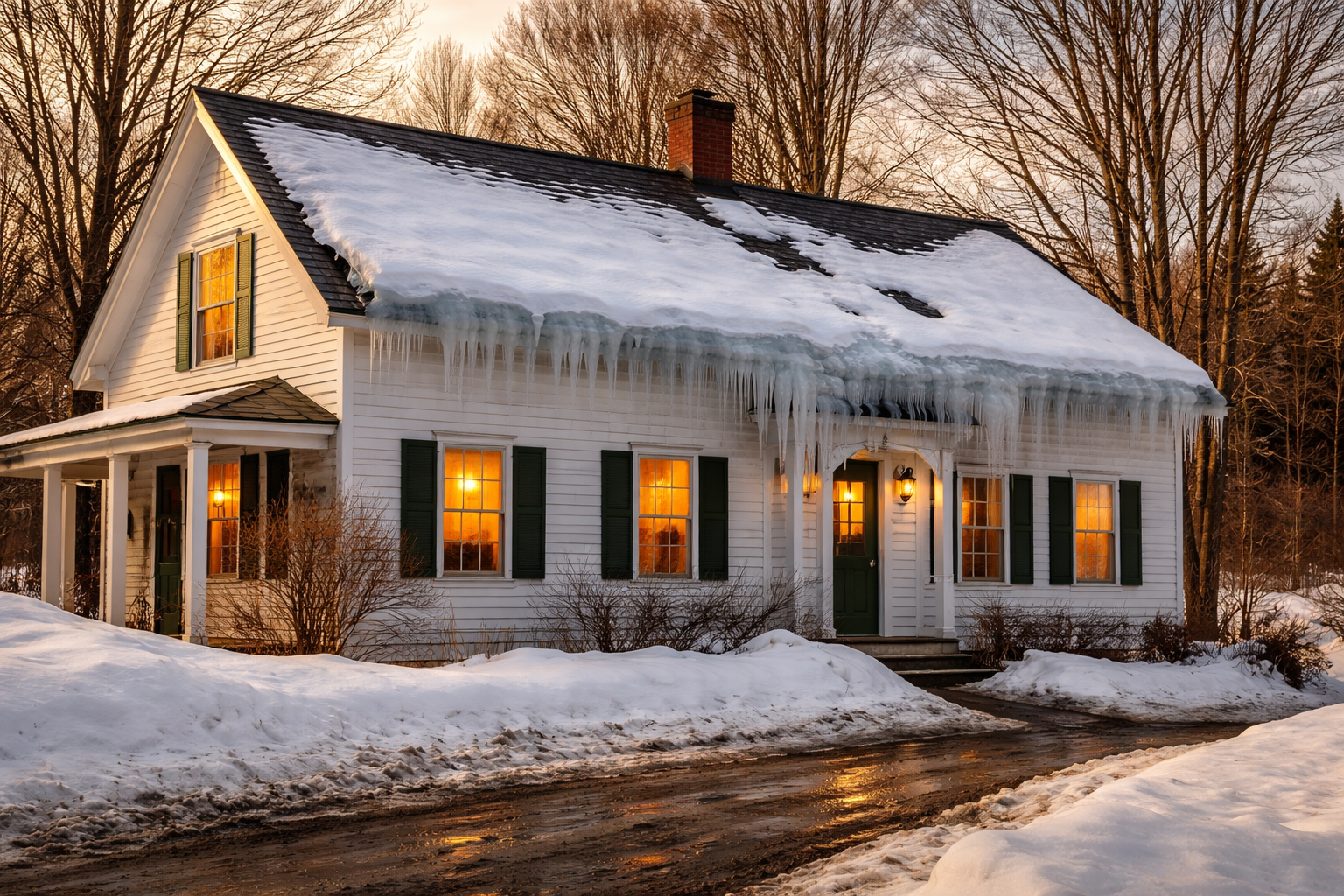
A classic Central Vermont scene: heavy ice dam loading the eave edge, icicles masking the water intrusion already working its way under the shingles.
Key Takeaways — Read This First
Two-Sentence Summary
Ice dams are a Vermont winter fixture, but the real damage — soaked insulation, rotted sheathing, stained ceilings, compromised air barriers — does not announce itself until the snow pulls back and mud season sets in. If you bought, sold, or currently own a Vermont home that carried roof ice this winter, the next four weeks are your window to catch it before minor moisture becomes a major repair bill.
If You Only Do 3 Things
- Get into the attic now — before the heat of spring masks the moisture staining, compressed insulation, and daylight gaps that ice dam intrusion leaves behind.
- Walk the roofline from the ground — look for lifted or missing shingles, staining on fascia boards, and soft spots in the soffit; these are the fingerprints of water that found a way in.
- Check every exterior wall below a roof valley or eave — press the drywall, look at the baseboard paint, smell for mustiness; ice dam water travels further inside a wall cavity than most homeowners expect.
The Walkthrough Moment
You are standing in a Vermont living room in early March. The ceiling has a faint brown ring — about the size of a dinner plate — directly below the roofline. The seller says it is old. Maybe it is. But right now, with ice still on the eaves and mud season a week away, that stain is a question that needs an answer before you sign anything — or before you list.
Here’s what I see in Vermont homes every single spring: the ice dam forms quietly over January and February. The icicles look almost decorative. Nobody goes in the attic. Nobody presses the drywall. And then the snow pulls back in March and April, and suddenly there is a water stain on the ceiling, a soft spot in the sheathing, insulation that looks like a wet sponge, and a repair bill that could have been caught for the cost of an hour and a flashlight.
This is not a catastrophe article. Ice dam damage is common in Vermont, it is well understood, and the fix ladder is clear. But the window to act — before moisture drives deeper into cavities, before mold gets established, before a buyer’s inspector finds it on the table instead of you finding it first — is right now.
What You Are Really Looking At
An ice dam is a ridge of ice that forms at the eave edge of a roof when heat escaping from a warm attic melts snow on the upper roof surface, the meltwater runs down to the cold overhang, and refreezes. The backed-up water has nowhere to go except under the shingles — and once it is under the shingles, it is inside your house. In Vermont, where a single winter can deliver a dozen freeze-thaw cycles, this process repeats all season long.
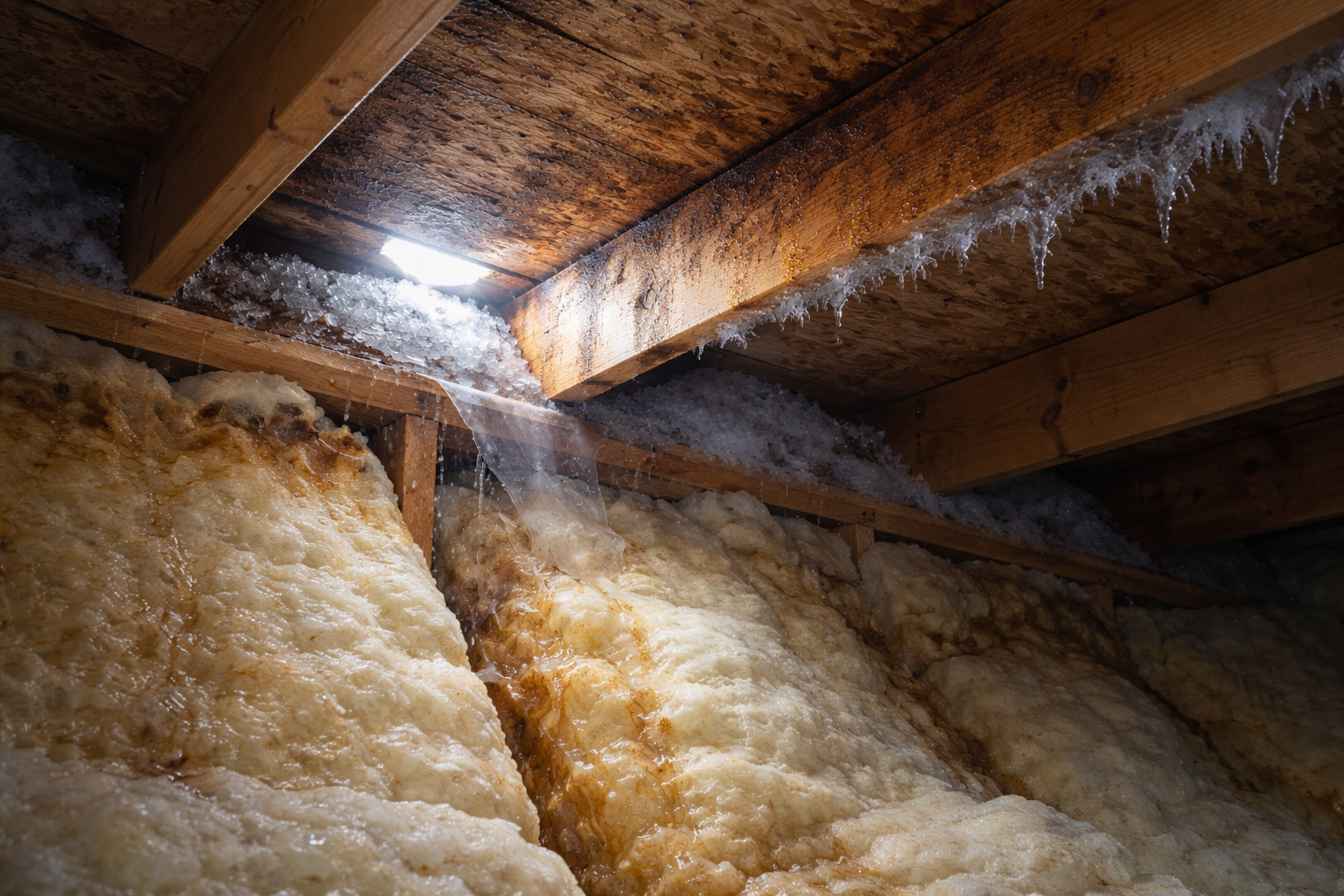
This is what ice dam intrusion looks like from the inside: stained sheathing, saturated insulation, and the early signature of mold. Most homeowners never see this until a home inspector does.
The Failure Sequence
Symptom: Brown ceiling stain, dripping during thaw, frost on attic sheathing, soft fascia board, peeling interior paint near exterior walls.
Cause: Heat loss through an under-insulated or poorly air-sealed attic floor warms the roof deck, melts the snowpack, and sends water downhill to the frozen overhang where it backs up under the first course of shingles.
Consequence: Water intrudes into the insulation layer, the roof sheathing, the wall cavity, and in persistent cases, the ceiling drywall. Saturated fiberglass batt insulation loses most of its R-value. Wet sheathing begins degrading. If the moisture persists through mud season without drying out, mold can establish in as little as 48 to 72 hours under the right temperature and humidity conditions.
What it is not: Ice dams are not a roof failure in themselves. They are a building-science symptom — a signal that the attic thermal boundary is not doing its job. Fix the boundary, and the ice dams stop forming.
Where to Look
- Attic sheathing at the eave end — look for dark staining, frost, soft spots
- Top of exterior walls in the attic — compressed or discolored insulation at the perimeter
- Ceiling directly below the eave — any brown ring or soft drywall
- Fascia boards and soffits from outside — staining, rot, paint failure
- Interior walls below roof valleys — bubbling paint, mustiness at baseboard level
Why Vermont Amplifies It
Vermont’s climate does not give ice dam damage a chance to dry out between events. A Central Vermont winter delivers repeated freeze-thaw cycles from November through March, heavy snowpack that can sit on a roof for weeks, and old housing stock — much of it built before modern insulation and air-sealing standards — that was never designed to hold heat at the attic floor. The result is a state where ice dam damage is not an outlier. It is a pattern.
The physics are straightforward. Vermont homes — particularly pre-1980 farmhouses, cape cods, and colonials — were built when heating fuel was cheap and attic insulation was an afterthought. Many have R-11 or less in the attic floor when current best practice for Central Vermont is R-49 to R-60. That gap in thermal resistance is exactly what feeds an ice dam: heat rises, escapes through the attic floor, warms the roof deck, melts the snow, and the cycle begins.
Compound that with Vermont’s roofline geometry. Steep pitches, dormers, skylights, roof valleys, and cathedral ceiling sections all create thermal irregularities — spots where heat escapes unevenly and ice concentrates. A home that looks fine from the street can have three or four distinct ice dam zones working simultaneously on the back side.
And then mud season arrives. Ground saturation is already high. Basement moisture is already elevated. The last thing a Vermont home needs in April is additional water migrating down through a compromised roof assembly into wall cavities that have no path to dry. That is when a manageable repair becomes a significant one.
The Fix Ladder
Ice dam remediation runs three levels: immediate damage control, professional removal and assessment, and the permanent building-science fix that stops ice dams from forming again. Most Vermont homeowners stop at level one or two and find themselves back in the same conversation the following March. The permanent fix — air sealing the attic floor plus adequate insulation — is the only one that actually ends the cycle.
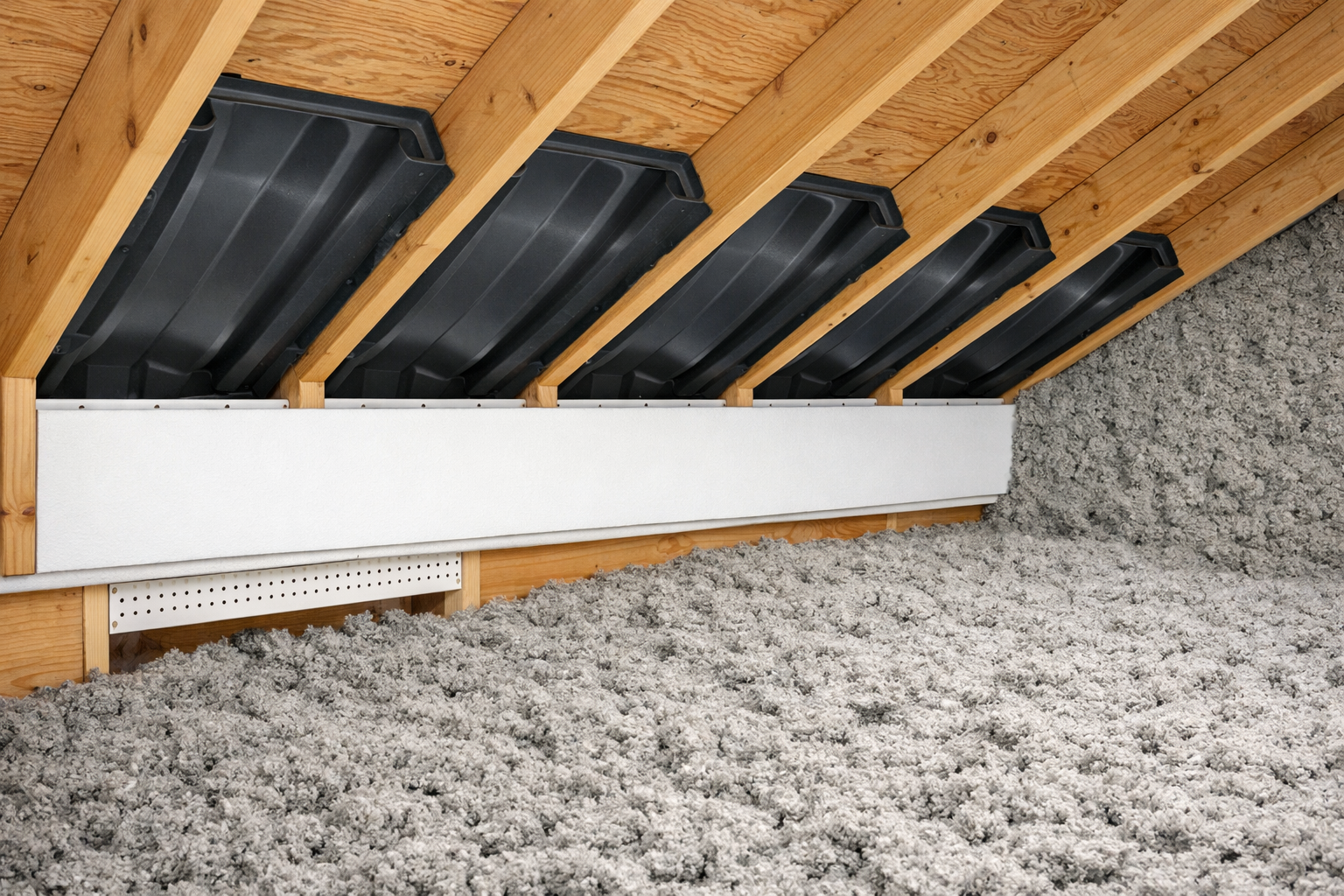
The correct fix: a continuous air barrier at the attic floor, adequate insulation depth, and preserved ventilation channels from soffit to ridge. This keeps the roof deck cold and uniform — no warm spots, no melting, no ice dam.
Level 1: Immediate / DIY
Typical cost: $0 to $150 in materials
- Use a roof rake to pull snow back from the lower 3 to 4 feet of the roof after each significant storm — this removes the fuel for ice dam formation
- Do not chip at existing ice with a hammer or ice pick; you will damage shingles and create new entry points for water
- Lay calcium chloride ice melt in a nylon stocking across the ice dam perpendicular to the eave — this creates a channel for meltwater to drain (do not use rock salt; it damages shingles and vegetation)
- Inside: place buckets, note the stain location precisely for your inspector or roofer, photograph everything
Level 2: Professional Removal and Assessment
Typical cost: $400 to $1,500 depending on roof size and access (estimate only; not a bid)
- Low-pressure steam removal is the professional standard in Vermont — it removes ice without shingle damage; avoid contractors who use pressure washers or chipping
- Once ice is removed, have a roofer assess shingle condition at the eave, inspect the first two courses for lifted nails, and check the ice-and-water shield (if present) for breaches
- Follow with an attic inspection — a home inspector or energy auditor can assess insulation condition, air sealing deficiencies, and sheathing moisture with a moisture meter
- If moisture readings in the sheathing exceed 19 percent (approximate threshold for mold risk), the assembly needs to dry before any repair work begins
Level 3: The Permanent Fix
Typical cost: $2,500 to $8,000+ depending on attic size, access, and existing conditions (estimate only; not a bid)
- Air seal the attic floor first — this is the step most contractors skip and the reason ice dams return; every penetration (plumbing stack, electrical box, recessed light, partition wall top plate) needs to be foam-sealed before adding insulation
- Bring insulation to R-49 minimum at the attic floor — dense-pack cellulose or open-cell spray foam are the typical Vermont choices; both have good performance in cold climates
- Preserve ventilation channels — baffles must be installed at every rafter bay from soffit to ridge to maintain airflow; insulation that blocks soffit vents creates moisture problems of its own
- Efficiency Vermont offers rebates for attic insulation and air sealing work that can offset a meaningful portion of the project cost — worth verifying current program availability before contracting
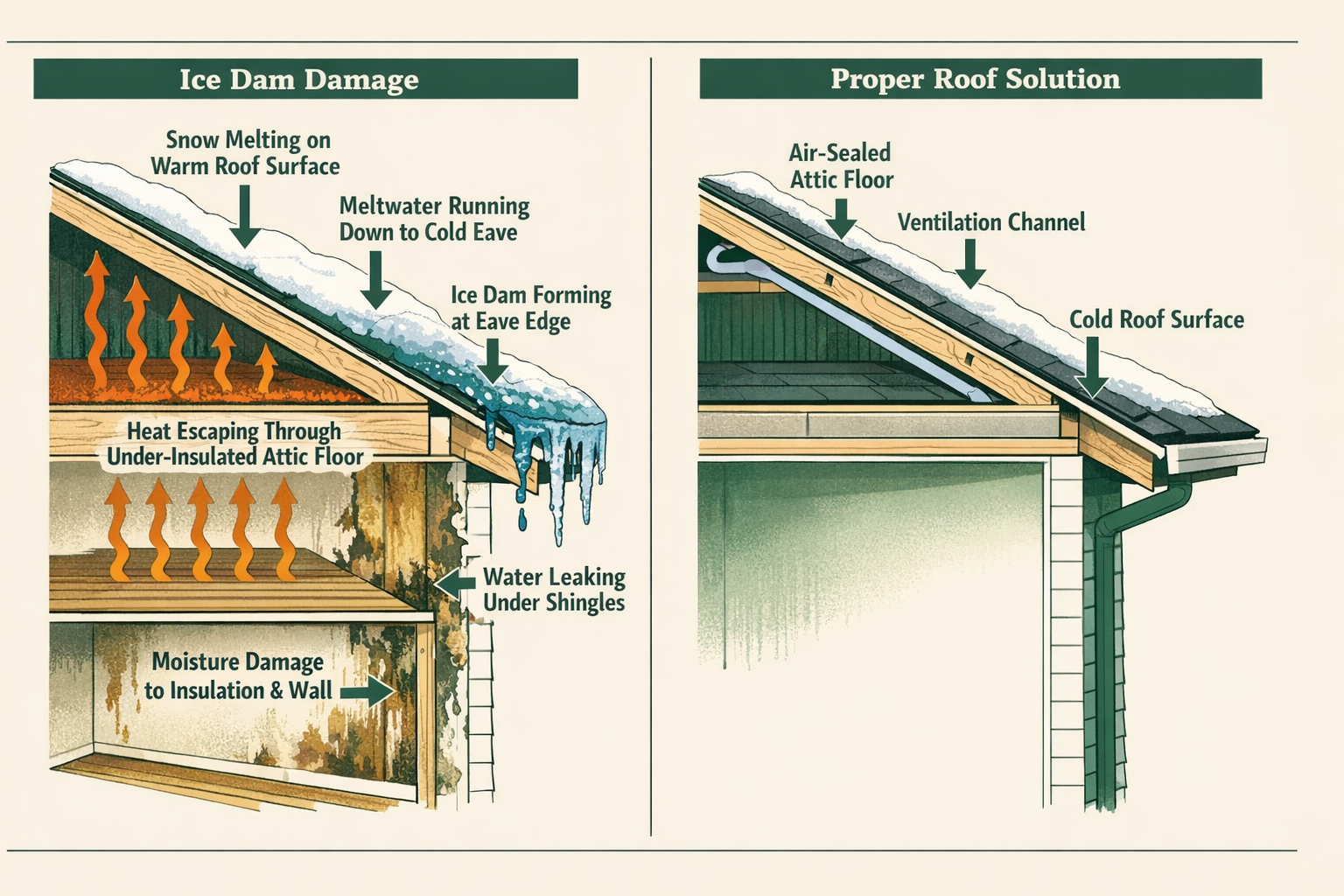
Left: the failure sequence — heat escapes, snow melts, ice dams form, water backs up under shingles. Right: the solution — a cold, uniform roof deck maintained by proper air sealing, insulation, and ventilation.
Buyer vs. Seller Checklist
Ice dam history is a legitimate and common disclosure issue in Vermont real estate transactions. Buyers need to know what to look for and what to ask. Sellers who get ahead of it — with documentation, a completed repair, or a clear-eyed disclosure — come out ahead of the ones who leave it for the inspection table. Neither side benefits from surprises in April.
If You Are Buying
- Ask the seller directly: has the home had ice dam issues? Any ceiling stains, attic moisture, or roof repairs in the last five years?
- Schedule your home inspection to include an attic inspection — not all inspectors go into attics by default; confirm this is in scope
- Ask your inspector to use a moisture meter on attic sheathing at the eave end — readings above 19 percent are a flag
- Look at the ceiling directly below the roofline in every room — faint brown rings, paint discoloration, or wavy drywall tape are all evidence of past water intrusion
- Press the drywall on exterior walls below roof valleys and dormers — any softness warrants investigation
- Ask for any Efficiency Vermont energy audit reports — these will document insulation levels and air sealing deficiencies directly
- If damage is found: request a repair or a credit; do not accept verbal assurances that “it dried out” without a moisture meter reading to confirm
If You Are Selling
- Get into the attic before you list — find the staining, compressed insulation, or sheathing damage yourself before the buyer’s inspector does
- If you have had ice dam issues, document what was done: dates, contractors, materials, any receipts
- A pre-listing energy audit from Efficiency Vermont is a strong move — it gives you documented insulation levels and positions you as a transparent seller
- Repair lifted shingles and damaged fascia before listing — these are visible from the street and will come up in every showing
- If the attic has moisture damage, dry it out and remediate before listing; wet wood smell in an attic is one of the fastest ways to lose a buyer at inspection
- Disclose known ice dam history — Vermont’s disclosure requirements are real, and a proactive disclosure with a completed repair is far stronger than a discovered problem
Bottom Line
Ice dam damage is one of the most common and most manageable issues in Vermont residential real estate — but only if you find it before mud season drives moisture deeper into the assembly. The order of operations is simple: look now, document what you find, act at the right level, and get the permanent fix on the schedule. Every week you wait is a week the moisture has to travel further.
This is a pretty common problem in Vermont. I have walked through it in hundreds of homes across Washington, Lamoille, and Chittenden Counties. The good news is that the failure mode is well understood, the fix ladder is clear, and most ice dam damage — when caught in the spring thaw window — is entirely solvable without a gut renovation.
What turns a manageable problem into an expensive one is time. Not the ice. The waiting.
Get in the attic. Take the flashlight. Look at the sheathing, press the insulation, check the moisture. If you are not comfortable doing that, or if you want a second set of eyes on what you find — that is exactly the conversation New England Landmark Realty (NELR) is set up to have. Send us the inspection report. We will translate it.
Got an Inspection Report? We’ll Translate It.
Found something in the attic and not sure what it means? Buying or selling a Vermont home and want a straight read on what the inspector found? Tony Walton and the New England Landmark Realty (NELR) team will triage what matters — no upsell, no alarm, just clarity.
Where to Go Next
- Vermont Home Buying Guide — Navigate the Central Vermont market with confidence
- Selling Your Vermont Home — Pricing, timing, and how to get ahead of inspection issues
- The Complete Vermont Home Inspection Guide for Buyers — What inspectors look for and why it matters
- New England Landmark Realty (NELR) — Central Vermont Real Estate

:format(webp):quality(80)/u.realgeeks.media/rgtemplate/Market-Report-2.png)