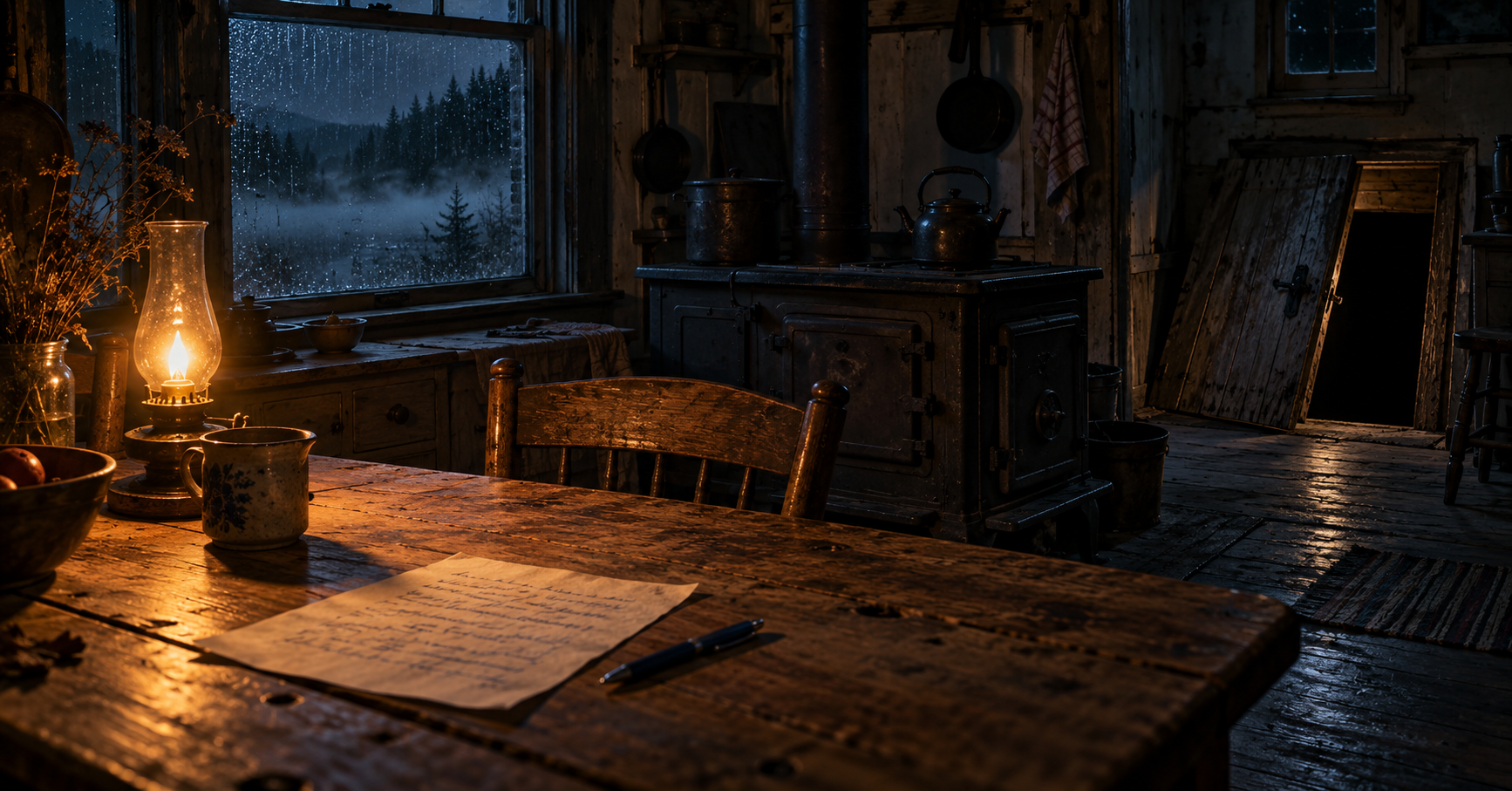
A Halloween story. Fiction, every word of it. Except the flood.
Every listing agent in Vermont knows the form. Seller's Property Information Report. Eight pages. Roof, septic, well, radon, the year somebody swore they replaced the furnace. And on the last page, the question nobody likes: Are there any other conditions a buyer should know about?
Most sellers write "No." Estates write "Unknown."
Unknown is the word the dead hide behind.
Marcy Lafleur had been selling houses around Middlesex for twenty-two years and had seen Unknown on maybe three hundred forms. So she didn't think twice when Arlene Bessette's nephew sent his back from Scottsdale by DocuSign with Unknown typed into every box, including the one asking how many bedrooms.
"I haven't been up there since I was nine," he said. Ice in a glass, the golf channel going behind him. "Aunt Arlene was... particular. Just sell it."
The Bessette place sat on the River Road where the Winooski makes its slow bend under the hills. It was a cape with a tired ell, a barn that leaned toward the water like it was listening, and a fieldstone cellar that had filled to the floor joists in November of 1927. The old-timers said it never really dried out.
Arlene had died in September, in her chair by the woodstove, ninety-one years old. The oil man found her. The stove was still warm, he said, which made no sense, because she'd been gone three days.
Marcy printed a blank copy of the form and left it on the kitchen table, the way she always did, to fill in her own notes on the second walk-through. She locked up, dropped the key in the lockbox, and drove home in the rain.
The next morning, the form was filled out.
Blue ballpoint. The old penmanship, the kind the nuns used to rap your knuckles over, every loop closed.
Roof: 2011. Ice dam over north bedroom. Pan under it.
Water: Drilled, 340 ft. Sweetest on the River Road.
Septic: 1988. Pumped every other fall. Mr. Tatro knows.
Cellar: Fieldstone. Wet since '27. Keep the door shut and the stove lit.
The lockbox app said nobody had been inside since Marcy, at 4:52 the afternoon before.
A neighbor, she decided. Somebody with a key from the old days. Vermont was full of spare keys under the second step.
She called Gary Tatro, who'd pumped half the septic tanks in Washington County. Every other fall since '88, he said. "Funny lady. Kept that stove going in July. Made me leave the truck running so the house wouldn't get quiet. Said when it gets quiet, that's when you listen."
Everything on the form checked out. So Marcy kept it.
(She'd tell herself later she meant to throw it away.)
It had been a wet October, the ground so soaked the fields squelched underfoot. The house went under contract that weekend to a young couple from outside Hartford, Josh and Kayleigh, with remote jobs and a baby on the way, the kind who say "the light!" in every room.
Every morning there was a new line.
The cellar floor was dirt until November 1979.
Lucien did not go to Quebec.
Marcy sat in her car in the dooryard a long time after that one. Everybody in Middlesex over sixty knew the story. Lucien Bessette, who drank. Who broke Arlene's wrist at the Grange dance in front of forty people. Who went north to cut pulp in November of '79 and never came back. Arlene never remarried. Never left the house. Never let the stove go out, people said, not once in forty-seven winters. They thought it was grief.
Don't let anyone go down when the river's up. The ground gives things back when it's wet. It did in '27.
Marcy's grandmother had told her about '27. The rain started at ten o'clock on the night of November 2nd, on ground October had already soaked through, and it didn't quit until the morning of the 4th. The Winooski came up in the dark. Fifty-five people died in this valley alone. In Bolton the river took a boardinghouse and nineteen people inside it. For weeks afterward people shoveled out cellars full of what the Burlington paper called "an endless chain of black filth." Her grandmother said the water wasn't the worst of it. The worst was the cries in the dark, and how by morning you couldn't tell which ones had come from the living.
Tell the inspector not to go down alone.
The inspection was Tuesday, November 3rd. Marcy didn't notice the date. Not then.
It had rained all night, a cold rain that didn't fall so much as hang. By noon the Winooski was brown and fast and over the lower field. Fog sat in the bend like something waiting to be let in. The kitchen was cold. Nobody had lit the stove since Arlene.
Marcy did not tell the inspector. You don't tell Ray Goulet, who has crawled through every cellar between Barre and Bolton since the Carter administration, that a dead woman left you a note.
She waited upstairs while Josh and Kayleigh measured the north bedroom for a crib. She heard Ray go down the cellar stairs, humming. Heard the humming stop.
Then she heard digging.
Small. Steady. Patient. Like a spoon scraping the bottom of a pot.
"Ray?"
The furnace kicked on with a whump she felt in her feet, and the cellar door eased shut on its own, slow as a held breath.
When she got it open, Ray stood at the bottom of the stairs with his flashlight on a patch of concrete in the far corner. It was six feet by three, the color of an old tooth, and it was sweating. River water beaded up through a crack down the middle, black and shining, and the crack was wider at the center, the way ice breaks when something pushes from underneath. On the beam above it, in heavy slanting pencil, a woodcutter had tallied his cords: L.B. 40 cd. Nov 79.
"Your sump pump's fine," Ray said, very calmly. "Tell them the sump pump's fine."
He came up past her. The tips of his fingers were raw, the nails split back to the quick, gray grit packed under them. Blood ran off his knuckles onto Arlene's clean linoleum. A lot of blood, for fingers.
"I didn't dig," Ray said, and she would remember his eyes for the rest of her life. "Marcy. I didn't dig. Something was digging up."
His report said nothing about the cellar. He retired in December and doesn't answer his phone.
The next morning there was one more line, and the blue ink had gone shaky.
I kept him down forty-seven years. I can't anymore. You tell them, Marcy.
Marcy thought about the commission, which was not small. She thought about Josh and Kayleigh and the light. She folded the form in thirds, took it home, and fed it through the shredder, all eight pages, and stood listening to it chew.
They closed in December. On New Year's, Kayleigh texted a photo: the baby in a bassinet in the kitchen, and the caption still haven't figured out the woodstove lol. The stove was cold. Behind it the cellar door stood open.
In February came the thaw. Rain on two feet of snow, gutters roaring, Marcy's own cellar drain gurgling like a throat. She came home from a showing in Moretown and found something on her kitchen table.
A Seller's Property Information Report. The address was hers.
Roof: 2004. Due.
Heating: Oil. The furnace is in the cellar.
Flood zone: It is now.
And on the last page, in heavy slanting pencil, the hand from the beam, pressed so hard it tore the paper:
THE AGENT DIDN'T TELL.
Beneath her feet, down in the wet dark, she heard it start.
Small. Steady. Patient.
Like a spoon scraping the bottom of a pot.
About the Flood
The people and the house in this story are invented. The Flood of 1927 is not. Rain began at 10 p.m. on November 2, 1927, on ground already soaked by a wet October, and fell until the morning of November 4. It killed 84 Vermonters, 55 of them in the Winooski River basin, including 19 people in a single Bolton boardinghouse.
Sources
- Vermont Historical Society: The Flood of '27
- VTDigger: Big wave of 1927 brought the worst flooding in Vermont history
- National Weather Service Burlington: The Flood of November 1927
Get Tony's Central Vermont market newsletter
Tony Walton, Principal Broker, New England Landmark Realty, Waterbury Center, Vermont. 802-233-4107.