Vermont’s Dual Real Estate Market: The Structural Shift We Can’t Ignore
Strategic Executive Summary
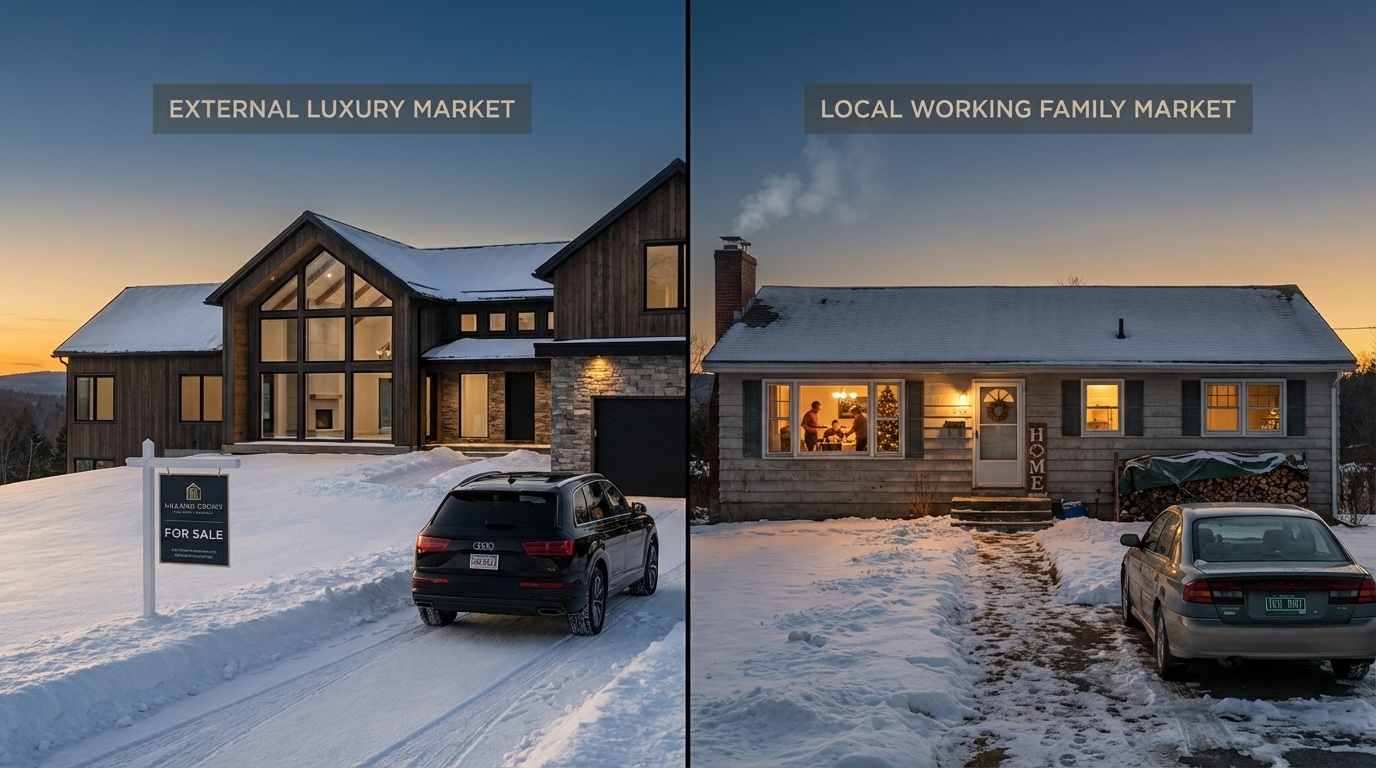
Vermont is currently operating under a dual-market system. One is fueled by local wages; the other by external equity. These two systems have become dangerously decoupled, creating a structural fragility that affects every buyer and seller in the state.
- For Sellers: Your equity is real today, but it depends on a shrinking pool of external buyers. Prioritize an "exit with certainty" over chasing a peak price that may have already passed.
- For Local Buyers: Do not mistake a "correction" for "affordability." Even if prices drop 10%, tighter lending and higher taxes often cancel out the savings. If the payment works for your 10-year plan, utility is more important than timing.
- For Investors: You are the liquidity in this market. Ensure your assets can survive a shift from "short-term vacation rental" back to "local residential fundamentals" if external demand continues to slow.
I’ve been in the trenches of Vermont real estate since 2003, and it is time to have a candid conversation about the mechanics of our market. Vermont's real estate environment isn't a single market. It's two separate systems stacked together, and we are currently seeing the gap between them widen.
Market #1: The External Liquidity Market
Today, Vermont's pricing floor is set by external liquidity. This market is dominated by out-of-state buyers importing equity from more expensive metros like Boston and New York.
The data is clear: Vermont has the second-highest rate of second-home ownership in the nation. When 41% of our housing stock is either rental, vacation-based, or vacant, we are no longer a local market; we are an equity-export destination. These buyers compete with cash or massive down payments, setting a price floor that local wages simply cannot reach.
Market #2: The Local Wage Market (Displaced)
While external buyers set the prices, the people who keep Vermont running—the teachers, tradespeople, and healthcare workers—must react to them. The numbers reveal a staggering gap: 91% of Vermont households are now effectively priced out of the median market ($385,000).
This dependency on external money is a fragility, not a strength. When that external "faucet" of equity slows down due to economic shifts in other states, Vermont's market loses its primary engine of liquidity. This is where the risk of a "freeze" begins.
The 2026 Warning: The Velocity Trap
We are entering a period of Stagnant Velocity. In this environment, prices may look high on paper, but the ability to sell (liquidity) disappears. A house "valued" at $600k that takes 10 months to sell is a liability for a seller who needs to move for a job or a family change.
Historical Context: Why This Time Is Different
During the Great Recession (2008–2010), Vermont home prices only fell about 5% on paper. However, when you adjust for inflation, it actually took seven years for Vermont home prices to recover in real terms.
In 2008, our market was more balanced. In 2026, we are far more dependent on out-of-state buyers. If that pool of buyers shrinks—which is already happening as Vermont saw the largest percentage population decline in the region in 2025—there is no local buyer base large enough to catch the fall. This is why resort towns like Stowe and Woodstock are often the "canaries in the coal mine."
The Bottom Line
We are transitioning from a market of speculation to a market of transactional reality. The period of "easy equity" is ending, and we are entering a period of price discovery. For anyone involved in Vermont real estate, the question is no longer "How much can I get?" but "How liquid is my position?"
Success in 2026 requires moving away from the "Zoom Boom" mindset and looking at the hard data. Whether you are holding, buying, or selling, your strategy should be based on long-term sustainability rather than short-term appreciation.
Ready to Navigate the Shift?
Whether you are evaluating your home's equity or trying to find a path to homeownership in Central Vermont, let’s talk through the data-driven reality of your options.
Tony Walton
Principal Broker, New England Landmark Realty
Waterbury, Vermont
Direct: (802) 233-4107
Email: tony@nelandmark.com
Web: www.nelandmark.com
Sources & Data References
- VT Legislative Joint Fiscal Office (JFO), "Housing Stock" fact sheet, 2025.
- Vermont Housing Needs Assessment 2025-2029, JFO Executive Summary.
- U.S. Census Bureau data via Vermont Futures Project, January 2026.
- Vermont Public Radio, "Vermont population declines again," Jan 2026.
- VHFA historical data on real vs. nominal price recovery (2008-2015).