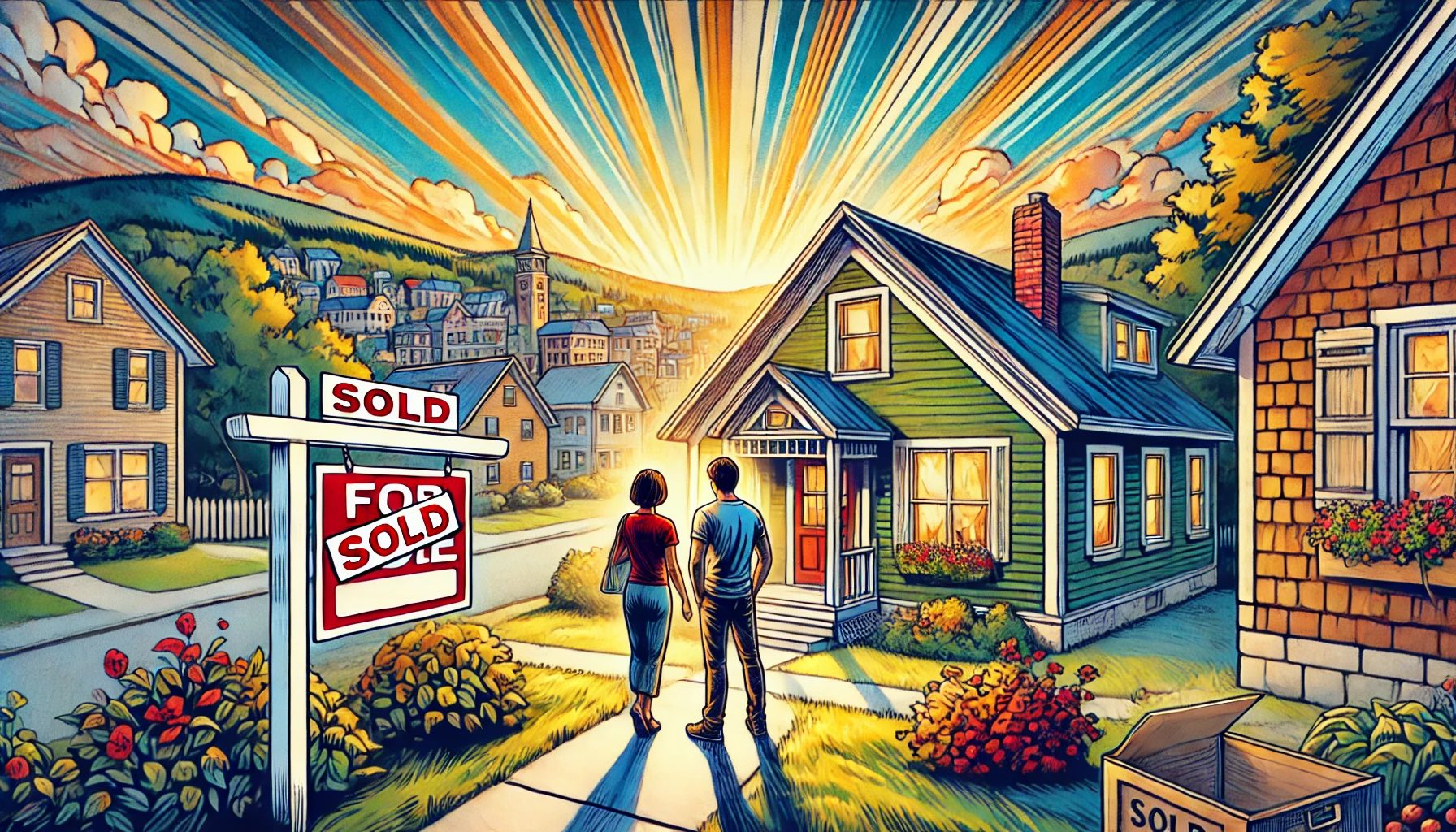
A Letter from Waterbury, Vermont
We’re Choosing the Postcard
On housing, property taxes, and second homes — and what kind of Vermont our kids inherit. Sent to my newsletter in January. Updated for September 2026. The numbers didn’t get better.
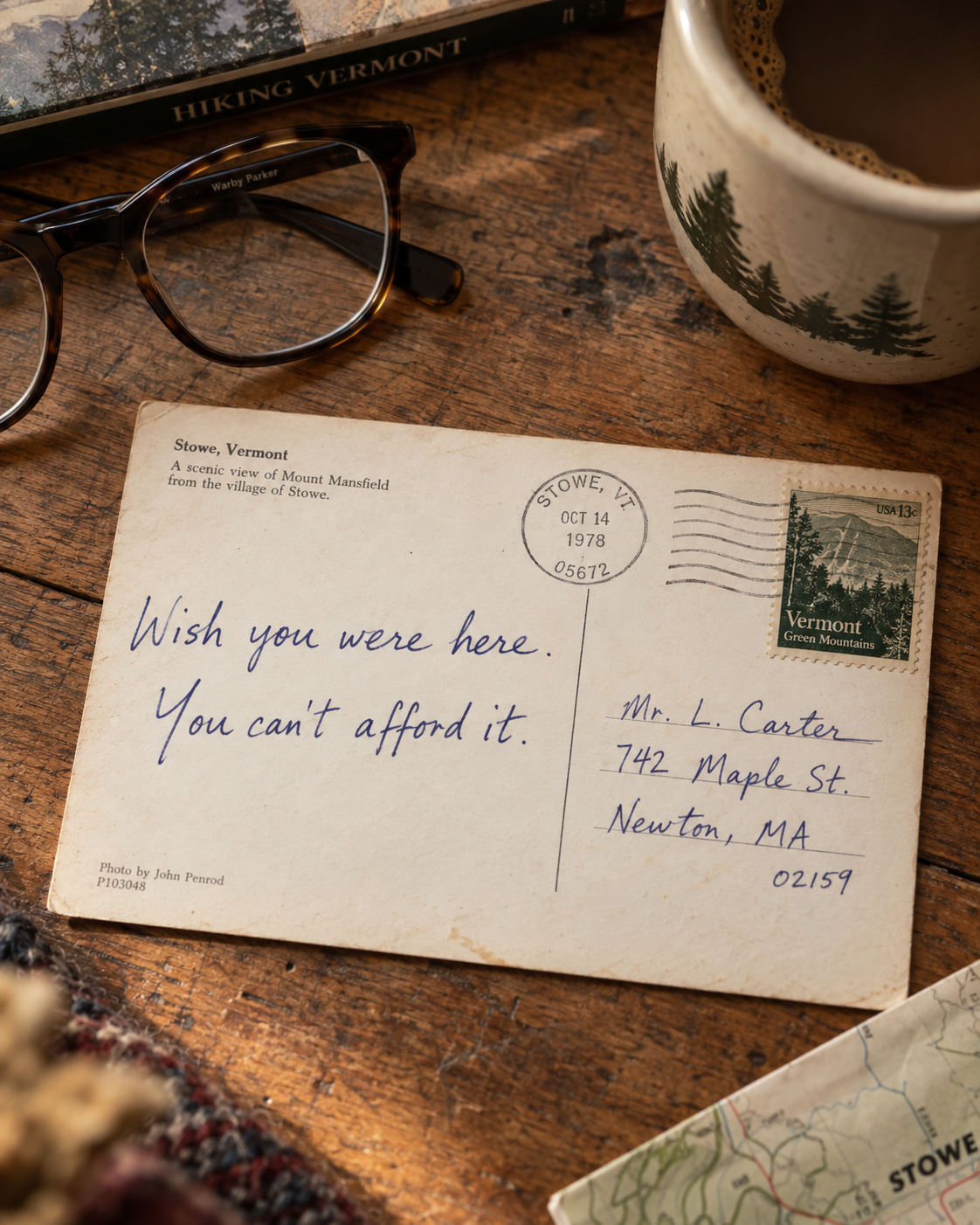
I was 12 years old when my family moved to Vermont in 1978. I’ve lived in Arizona, Texas, North Carolina, and Idaho since then—but I’ve called Vermont home for nearly five decades. I came back full-time in 1998 with a belief that this was still a place you could build a life if you were willing to work hard and show up for your community. I’ve raised two sons here. I’ve served on nonprofit boards and sold real estate for over 20 years through the Great Recession, the COVID crash, and two housing bubbles. I love this place.
But I’m watching Vermont hollow out, and the conversation we’re having about why is mostly bullshit.
I wrote this in January and sent it to my newsletter. Some of you read it. Most of Vermont didn’t. Last week I checked every number again before posting it here, and here’s the thing: the numbers didn’t get better. Some got worse. A few changed shape entirely—and one of them will be on your ballot November 3rd.
Let me be clear: I’m a real estate broker. I’ve made a living selling homes to out-of-state buyers, second-home purchasers, and retirees with big-city equity. I’m not anti-wealth. I’m not anti-growth. I’m not some Bernie-bro socialist who thinks private property is theft.
But I’m also a Vermonter who chose to come back and stay, who watches essential workers leave because they can’t find housing, and who’s tired of pretending the market will magically fix a problem we’ve spent 20 years creating through policy choices that prioritize aesthetics over people.
So let’s stop lying to ourselves. Here’s what’s actually happening.
Part OneThe Museum Economy: When Vermont Becomes a Postcard, Not a Place
Vermont has become a museum for rich people to visit. We’ve built an economy that extracts value from elsewhere while making it impossible for the people who actually make Vermont function to afford to stay.
The math is brutal. Vermont’s median home price is now around $412,000—up roughly 148% since 2001 and still inching upward even as the market cools. Median household income over that same quarter-century? Up about 72%. It sits near $85,000 today. Which means over 90% of Vermonters cannot afford the median-priced home without being severely housing-cost-burdened.
The Brutal Math — Statewide, September 2026
Figures: Redfin (median price, early 2026); U.S. Census/FRED (median income); 2025 Vermont Housing Needs Assessment and VHFA (renter affordability, vacancy, shortfall) — compiled September 2026. Renter-affordability and vacancy figures reflect the latest published assessment data.
In 2019, a Vermonter earning the median income could afford roughly half the homes on the market. By 2024, that dropped to one-third. And if you’re a renter hoping to buy? Only about 6% of Vermont renters have the income needed to purchase a median-priced home, down from roughly a third in 2021. The rental vacancy rate is 2.5%. There is essentially nothing to rent and nothing to buy.
Translation: We’ve priced out the teachers, the nurses, the carpenters, the restaurant workers, the nonprofit staff—everyone who makes Vermont more than a scenic backdrop for weekend Instagram posts.
And here’s the twist nobody predicted: the market finally cooled, and it still didn’t fix anything. Inventory is up nearly 12% from last year. Homes are sitting a median of about 90 days. Sellers are getting around 96 cents on the dollar instead of bidding wars. For the first time since before the pandemic, this feels like a functioning market.
But prices are still climbing—because 2.9 months of supply is nowhere near the 4 to 6 months a balanced market needs, and the shortage underneath the cooling is still 24,000 to 36,000 homes. The ice melted. The water’s still freezing.
Part TwoThe Property Tax Trap (Updated)
Meanwhile, property taxes have risen roughly 40% over the past five years. This session the Legislature passed a $100 million one-time buy-down that cut the average projected increase from about 7% to about 3.5%. Homeowners breathed a sigh of relief.
They shouldn’t—not because the relief wasn’t real, but because of how it was bought. That’s the third straight year we’ve papered over structural costs with one-time money. That’s not a funding strategy. That’s burning the furniture to heat the house.
Homeowners are furious. They’re blaming school budgets. They’re showing up at town meetings demanding cuts. And I get it—when your tax bill jumps $1,200 in a year, you want someone to blame.
But here’s what nobody wants to say out loud: Your property taxes aren’t high because schools are greedy. They’re high because we stopped growing the tax base.
Student enrollment is down. We’re educating fewer kids than we were 10 years ago. But we’re trying to maintain 1970s-era school infrastructure across 200+ towns with half the population density to support it. And because we’ve blocked housing development, blocked commercial growth, and made it nearly impossible to build anything anywhere affordably, the taxable grand list hasn’t grown fast enough to spread those costs across more properties.
So we squeeze existing homeowners harder. And harder. Until they break.
That’s not a school spending problem. That’s a we-refuse-to-grow problem. The 2026 session’s education bill—seven new regional service areas, a new funding formula by 2030, and school construction aid restored for the first time since 2007—is real progress. But none of it works if the tax base keeps shrinking under it.
Part ThreeThe Second Home Conversation Nobody Wants to Have
Here’s the part where I lose some friends.
Vermont has a second-home problem. Not because second-home owners are bad people—many of them love Vermont as much as I do, contribute to local nonprofits, and spend money in our communities. But because when your vacation home sits empty 35–40 weeks a year while the teacher coaching your kid’s soccer team is commuting 45 minutes from another county because she can’t afford rent in town, we have a resource allocation problem.
The numbers, for the record, because the campaign rhetoric is already loose with them: Census data counts roughly 50,000 seasonal homes in Vermont—about 14% of our housing stock. VHFA’s analysis suggests about 35,500 are fit for year-round living. The Tax Department, casting a wider net, has flagged around 70,000 properties that could fall under a second-home tax. And about 12,000 properties operate as short-term rentals. Pick your number—every one of them is too high for a state that can’t house its nurses.
When I wrote this in January, the Legislature was still debating whether to reclassify second homes at all. Here’s where it actually landed: the 2026 education reform law wrote the third classification into statute. Homestead. Non-homestead nonresidential. And non-homestead residential—second homes. The framework is law. The rate isn’t set until 2029, it takes effect in 2030, and it disappears entirely if a future Legislature loses its nerve.
Meanwhile, the tools we already passed are underdelivering. The one-time tax on second-home sales has applied to roughly 7,300 purchases in two years and raised about $28 million—real money, but less than projected. The 3% short-term rental surcharge is collecting its pennies. We’re making progress at the speed of a zoning board of appeal.
And now the question goes to the ballot. Every Democrat who ran for governor or lieutenant governor this year campaigned on taxing second homes. The incumbents say they want to grow the tax base instead of adding taxes. The general election is November 3rd.
So here’s my ask of every candidate who knocks on my door this fall: Skip the slogan. Tell me the rate. Tell me the year. And tell me what you’ll do in 2029 when the postcard lobby calls it class warfare.
Because I’ll say what I said in January: when a wealthy out-of-state buyer outbids a young Vermont family by $50,000 because they can pay cash and plan to use the house six weeks a year, that’s not “the market working.” That’s wealth inequality playing out in real time, and pretending otherwise is cowardice.
I’ve sold second homes. I’ll probably sell more. But let’s not pretend there’s no tension here. If you’re going to own property in a place with a housing crisis, you’re going to help pay for the schools and services that make this a place worth owning property in. If that makes Vermont less attractive as a second-home investment? Good. We need homes for Vermonters more than we need more investment properties.
Part FourThe Building Problem We Won’t Name
Vermont’s own Housing Needs Assessment says we need somewhere between 24,000 and 36,000 additional year-round homes by 2029—the 40,000-by-2030 goal gets quoted too. In the past five years, we built fewer than 16,000 units. We are not going to make it. Not close.
Why? Because we’ve spent 50 years making it nearly impossible to build anything.
Act 250 was passed in 1970 to protect Vermont from becoming New Jersey. Noble goal. But it’s now a permitting gauntlet that adds 12–24 months and $40,000–$80,000+ to every project that triggers jurisdiction. The recent reforms (the new tiering system) are a step forward—they exempt some housing in designated growth areas. But they also increase scrutiny in rural areas, which is where most buildable land still exists.
And even without Act 250, you’ve got local zoning boards, design review committees, NIMBYs showing up to every public hearing to complain about “character” and “density” and “traffic,” and a culture that treats every new housing development like an existential threat to Vermont’s soul.
Here’s the thing: Vermont’s soul isn’t its zoning code. It’s the people who live here. And right now, we’re choosing aesthetics over people. We’re choosing “viewsheds” over teachers having a place to live. We’re choosing “I don’t want apartments near my house” over young families staying in the state.
The Legislature has also debated banning corporate entities from buying single-family homes in Vermont. It sounds tough. It feels good. And it will accomplish almost nothing, because Vermont’s housing problem isn’t Blackstone buying up subdivisions—it’s individuals outbidding locals, landowners sitting on buildable parcels waiting for appreciation, and towns blocking every development that comes before them.
Banning corporate buyers is political theater. It lets us feel like we’re doing something without confronting the hard truth: We are the problem. Our refusal to build. Our refusal to say yes to housing. Our refusal to accept that Vermont in 2026 can’t look exactly like Vermont in 1978.
Part FiveThe Coming Reckoning
Here’s what happens if we don’t fix this.
In 10 years, Vermont will be a state of retirees, remote workers with out-of-state incomes, and vacation homes. The median age will push past 50. The schools will consolidate further because there won’t be enough kids to justify keeping them open. The volunteer fire departments will collapse because there won’t be enough working-age adults to staff them. The restaurants and ski resorts will close early or reduce hours because they can’t find workers—because workers can’t find housing.
And the Vermonters who do stay will be the ones who inherited property or who are willing to be housing-cost-burdened at 50%+ of their income just to avoid leaving.
That’s not a functioning society. That’s a theme park with a property tax problem.
Some of you reading this will say: “Tony, you’re exaggerating. The market will correct. Supply and demand always balance out.”
No. They don’t. Not when policy strangles supply for decades. Not when wealth concentration allows a small number of buyers to outbid everyone else indefinitely. Not when “the market” is designed to allocate housing to the highest bidder, regardless of whether that person actually lives here.
The market is working exactly as designed. It’s just not designed to prioritize Vermonters.
Here’s the part the market optimists missed this year, though: Vermont just showed you what a real correction looks like, and it wasn’t a crash. Inventory rose. Days on market doubled. Sellers settled for 96 cents on the dollar. And median prices still went UP. That’s what a correction looks like in a state with a 25,000-home deficit. Even the relief rallies toward unaffordable.
Part SixWhat It Takes to Fix This (And Whether We Have the Guts)
I’m not naive. I don’t have a magic policy that solves this overnight. But I know what doesn’t work: pretending this is a temporary blip, blaming schools for tax increases, and blocking every housing development because it might change the view.
Here’s what actually moves the needle:
- Say yes to housing. Not just “affordable housing” in someone else’s town. All housing. Market-rate, workforce, senior, rental, ownership—everywhere, all the time. Because vacancy rates matter, and if you’re not building housing, you’re rationing it by price. And right now, locals are losing that auction.
- Finish the second-home tax. The framework is already law—the classification was written into statute this year. Now set the rate, set it before 2029, and make it survive contact with an election. If your property sits empty 40 weeks a year or operates as an Airbnb instead of housing Vermonters, you should pay more to support the community infrastructure you’re using. That’s not class warfare. That’s recognizing that housing has a social function beyond ROI.
- Reform permitting. Act 250 reform is a start, but it’s not enough. Local zoning needs to allow as-of-right development in growth areas—no design review, no conditional use hearings, no six-month appeals process. If it meets code, it gets built. Otherwise, we’re just pretending to care about housing while ensuring nothing actually happens.
- Use public land to build housing. The state’s inventory of state-owned land for housing should move faster. If private landowners won’t develop, the public sector should. And if that makes you uncomfortable, ask yourself: Why should your speculation matter more than a nurse’s ability to live near the hospital?
- Stop blaming schools and start growing the tax base. Education spending isn’t the problem—it’s that we’ve refused to build the housing and commercial tax base that funds education. You want lower property taxes? Build 5,000 housing units in the next three years. Watch what happens to your rate.
But here’s the real question: Do we actually want to fix this, or do we just want to complain about it?
Because fixing it means accepting that Vermont will look different. It means saying yes to housing developments that don’t look like restored 1850s farmhouses. It means higher density in town centers. It means your property value might not appreciate at 6% annually forever. It means second-home owners might pay more in taxes. It means some of the postcard aesthetics you moved here for might change.
And I’m not sure we’re willing to make that trade.
Part SevenThe Sliver of Hope (Because I’m Still Here)
Here’s what gives me hope: Vermonters have always been pragmatic problem-solvers when we stop posturing and start working.
I’ve watched this state rebuild after floods. I’ve watched small towns come together when someone loses a barn or a house. I’ve watched neighbors show up for each other in ways that would shock people from places where “community” is a marketing slogan.
That capacity is still here. The question is whether we’ll deploy it before it’s too late.
The new “Let’s Build Homes” nonprofit is a signal. Burlington’s housing push is a signal. The state inventorying public land is a signal. This year’s education law—with its restored school construction aid and its regional structure—is a signal. These are people refusing to accept that Vermont’s best days are behind it.
But signals don’t build houses. Political will does. Money does. Saying yes does.
And if we can’t muster that—if we keep choosing aesthetics over people, tax relief over growth, and nostalgia over survival—then we’re not solving a housing crisis. We’re managing a decline.
I didn’t come back to Vermont in 1998 to watch it become a museum. I came back because it was still a place you could build a life, raise a family, and be part of something bigger than yourself.
That’s still possible. But the window is closing.
So here’s my question for all of us—the longtime Vermonters, the new arrivals, the second-home owners, the developers, the selectboard members, the legislators, and everyone in between:
What kind of Vermont do you want your kids to inherit? A living, breathing community where working people can afford to stay? Or a scenic postcard where only the wealthy can play?
Because right now, we’re choosing the postcard. And we’re running out of time to change our minds.
Tony Walton
Principal Broker, New England Landmark Realty · Waterbury, Vermont
(802) 233-4107
Tony@nelandmark.com
nelandmark.com
If you want to talk about what’s actually happening in Vermont real estate—not the polished version, the real version—call me. If you want to yell at me for writing this, call me anyway. But if you want to pretend everything’s fine, save us both the time.
Sources: Redfin; Vermont Housing Finance Agency; 2025 Vermont Housing Needs Assessment; Vermont Department of Taxes; Vermont Public (Aug. 3, 2026); 2025–2026 Vermont legislative session summaries. Market figures current as of September 2026.