Rates hit a 3.5-year low on February 26th. Then Iran happened. Here's the exact dollar math on what that rate move costs a Vermont buyer — and what the decision to wait actually buys you.

What Changed — And the One Number That Matters
Direct Answer
The 30-year fixed mortgage rate hit 5.98% on February 26th — the first sub-6% reading since 2022 — then jumped back to 6.00% within one week as U.S.-Israeli strikes on Iran drove oil prices higher and rattled the bond market. For Vermont buyers using 5% down on a median-priced home, that single basis-point move is the difference between momentum and paralysis. The action: don't wait for the rate to return. Get pre-approved at today's number.
Let's run the numbers. On February 26th, Freddie Mac published a figure that hadn't appeared in three and a half years: 5.98% on a 30-year fixed mortgage. The bond market was cooperating. The 10-year Treasury yield had slipped to 3.96%. Phones were ringing.
Then the bombs fell. U.S. and Israeli strikes on Iran over the weekend of March 1st sent oil prices surging and inflation expectations back up. The 10-year Treasury yield jumped from 3.96% to 4.13% in five trading days — 17 basis points. Mortgage rates followed. By March 5th, Freddie Mac reported 6.00%. The sub-6% window lasted exactly one week.
Translation: the rate environment didn't get dramatically worse. It got uncertain. And in real estate, uncertainty has a price — and that price is paid by the people who wait for clarity that may not arrive on schedule.
Here's What the Data Tells Us
Direct Answer
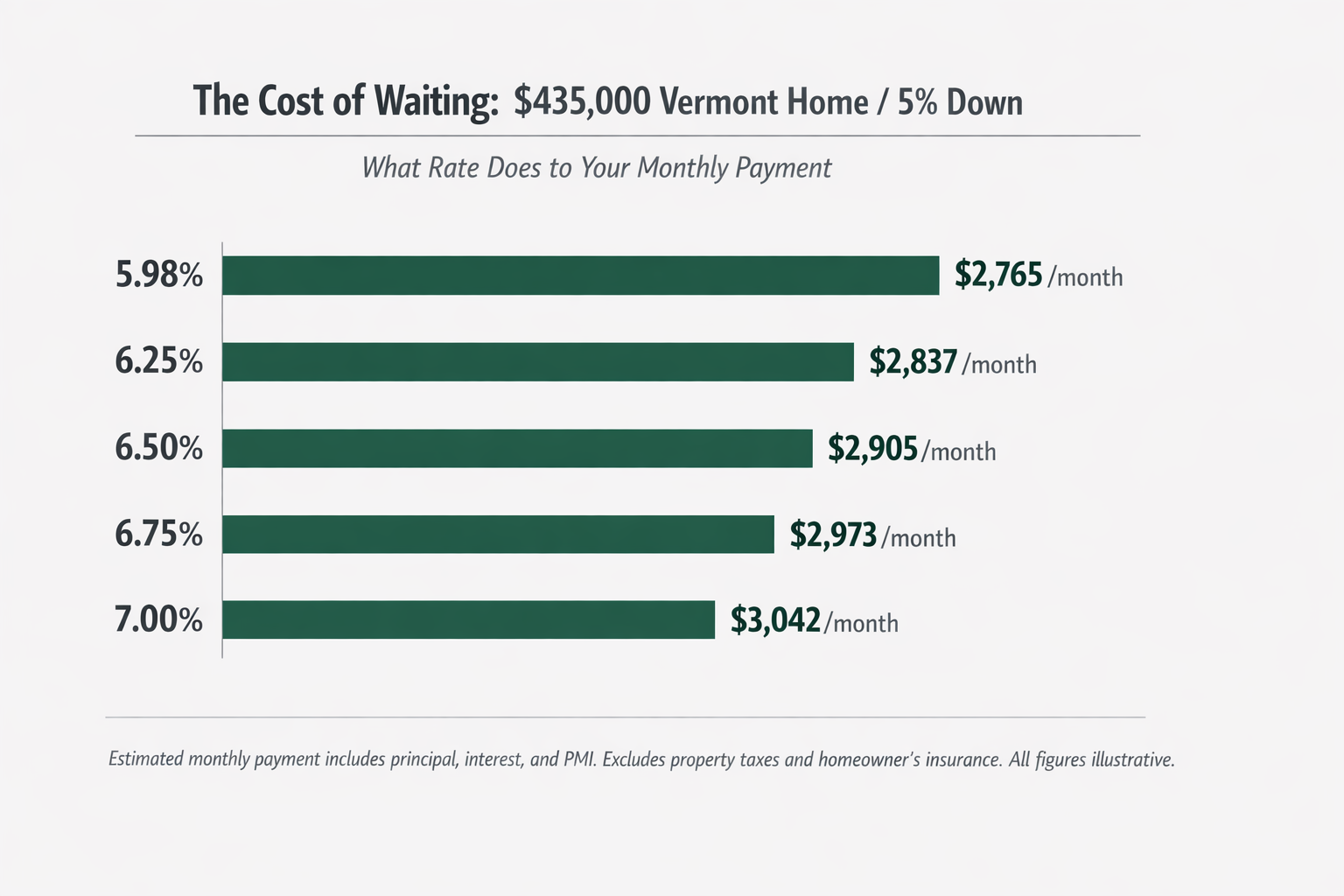
On a $435,000 Vermont home with 5% down, today's all-in monthly payment (principal, interest, and PMI) is approximately $2,765. If rates rise to 6.75% — the Iran escalation scenario — that payment becomes $2,973. That's $208 more per month, $2,496 more per year, and $74,880 more over the life of the loan. Vermont's median home price sits at approximately $435,000, up roughly 5% year-over-year. Vermont inventory is at 2.9 months of supply — still a seller-aligned market. The action: model your own scenario against the table below before rates make the decision for you.
Five rate scenarios. One Vermont home. Here's what each one actually costs you — not in abstract percentage points, but in dollars out of your account every month.
| Rate | Scenario | Monthly P&I + PMI | vs. Sub-6% Window | Per Year |
|---|---|---|---|---|
| 5.98% Feb 26 window | 3.5-yr rate low | $2,765 | — | — |
| 6.00% Today | Freddie Mac, March 5 | $2,771 | +$6/mo | +$72/yr |
| 6.30% | Base case plateau Q2 | $2,851 | +$86/mo | +$1,032/yr |
| 6.75% | Iran escalation scenario | $2,973 | +$208/mo | +$2,496/yr |
| 7.00% | Full oil shock | $3,042 | +$277/mo | +$3,324/yr |
$435,000 home · 5% down ($21,750) · $413,250 loan balance · PMI estimated at ~$293/mo (illustrative) · Excludes property taxes and homeowner's insurance · All figures illustrative
So What Does That Mean for Vermont?
Direct Answer
Vermont's median single-family home price sits at approximately $435,000 — up roughly 5% year-over-year — and active inventory is at just 2.9 months of supply, well below the 4–6 month balanced-market threshold. That structural reality doesn't change with the headlines. Vermont buyers are not competing against a loosening market; they're competing against other buyers in a constrained one. The action: understand that the rate is the variable. The supply constraint is the constant.
Here's what the national coverage misses. Vermont is not a financial hub. We don't have an embassy that can be rocketed. What Vermont has — and what the data consistently confirms — is a buyer demographic that accelerates toward this state during national instability, not away from it.
Remote workers. Second-home buyers. Equity-rich relocators leaving Boston, New York, and D.C. These are the buyers who move Vermont's market. And they don't stop wanting to be here because the Middle East is on fire. That pattern isn't spin. It's thirty years of watching this market breathe through 9/11, 2008, COVID, and now this.

The inventory picture reinforces this. Active listings in Vermont are up 33.6% year-over-year — which sounds like relief. But 2.9 months of supply is still firmly seller-aligned. A balanced market sits at 4–6 months. Vermont isn't there yet. More options doesn't mean a buyer's market. It means a disciplined seller's market with better manners.
So what does the rate environment actually change in Vermont? It changes the entry price for buyers on the margin. First-time buyers, younger buyers, buyers stretching to make the monthly number work — those buyers feel every basis point. The $208/month difference between today and the escalation scenario is a car payment. It's a ski season. It's real.
Bottom Line
Direct Answer
The rate environment is uncertain in a way it wasn't three weeks ago. But the structural Vermont market argument — tight inventory, durable demand, resilient buyer base — has not changed. Waiting for certainty is a strategy, but it has a cost: every week of higher rates is a week of higher carrying costs and reduced purchasing power. The play is to get pre-approved now, model your scenario, and move when the right home arrives — not when the geopolitical calendar cooperates.
Here's the Play
If you're buying
You're not buying a stock. You're buying land in one of the most stable, community-rich states in America. The rate you lock today you can refinance when the world calms down. The house you lose to another buyer while you're waiting for clarity is gone. Get pre-approved. Know your number. Be ready to move.
If you're selling
Your equity is real. Your market position is strong. Vermont inventory is still lean at 2.9 months. The demographic wave driving demand here doesn't reverse because of geopolitical turbulence — historically, it deepens it. Price right. Show well. The buyers who qualify are motivated, and right now they're watching the same headlines you are.
If you're on the fence
Define your number. Write it down. "I'll move when rates hit X, when I find a home at Y price, when my situation allows Z." That's a strategy. Vague waiting isn't. The fence just got more expensive — every week of rising rates and rising prices is a week of reduced purchasing power. Clarity isn't coming fast. The house on the hill in Waterbury isn't getting cheaper.
Ready to Talk Vermont Real Estate?
Whether you're running numbers, weighing a sale, or ready to make your move —
the New England Landmark Realty team is here for a straight-shooting conversation.