New England Landmark Realty covers the Vermont real estate market 

from the inside — market data, buyer strategy, seller timing, land 

use regulation, and the policy decisions shaping what homes cost and 

who can afford them.


Tony Walton has been working Vermont real estate since 1978. 

The analysis here reflects that depth.


Browse by topic below, or use the search to find what you need.

Sept. 5, 2023

Housing starts tick back up in July in spite of headwinds


August 16, 2023, 2:33 pm By 

Housing starts picked up significantly in July to a seasonally adjusted annual rate of 1.452 million, according to the U.S. Census Bureau. That was up 3.9% from June and up 5.9% from a year ago. Meanwhile, permits for future construction eked a 0.1% gain from June but were 13% lower from a year ago.

The increase in housing starts came after an unexpected slump last month and beat expectations. The Census Bureau also adjusted June’s figures down to 1.398 million from 1.43 million.

Overall, single‐family housing starts in July came in at a rate of 983,000. This is 6.7% above the revised June figure of 921,000. The July rate for units in buildings with five units or more was 460,000. Single-family permits increased (+0.6%) to 930,000 in July while multifamily permits came in at 464,000.

Completed homes fell 11.8% from the prior month and were 5.4% below the July 2022 level. The pace of single-family home completions picked up from the prior month, boosted by gains in the Midwest and West.

Meanwhile, there are just over one million multifamily units under construction, a record.

Still, it’s a good, not great report, economists said. Housing starts have been down for 13 of the last 15 months on a year over year basis. And the NAHB/Wells Fargo builder confidence index also fell in August, the first decline in 2023.

Declines in the current pace of sales and the next six months pushed the index down, said George Ratiu, chief economist at Keeping Current Matters. 

In spite of the affordability challenges, homebuyers remain eager to buy. Developers and construction companies seem to “have come to terms with the affordability challenge and have been erecting smaller homes at more approachable prices this year,” said Ratiu. 

Though there are near-term and medium-term challenges with mortgage rates and waning affordability, the fundamentals still look good, economists said.

“Higher mortgage rates threaten affordability and builder supply-side challenges remain, but the housing market remains fundamentally underbuilt and existing homeowners aren’t moving,” said Odeta Kushi, deputy chief economist at First American. “While builders can’t make existing homeowners move, they can add more new homes to the housing stock.”

Completions were down in July, but that is about one year after permits and starts began to decline, leaving fewer homes in the pipeline and thus dampening completions, said Nicole Bachaud, an economist at Zillow.

“New construction remains a vital source of new inventory in this market, with many builders still offering incentives that allow for more buyers to find opportunities in the new homes market, so continuing to build is important to the overall health of this market,” she said.

There are other challenges for prospective homebuyers to overcome, said Travis Hodges, a managing director at insurance brokerage VIU by HUB. It’s become much more difficult to secure homeowners insurance in several markets, and rising costs are a big concern.

“With insurance premiums expected to be up 7% this year on average, finding coverage at a reasonable price is key for new home buyers to carry a mortgage,” Hodges said.

States like California and Florida, which are both prone to extreme weather events, are now facing issues of multiple carriers leaving the market. A similar situation might happen in Maui after catastrophic wildfires destroyed parts of the island. 
Posted in
Sept. 2, 2023

Why the Fed is celebrating after jobs week

September 1, 2023, 6:26 pm 

By 

Jobs week cleared up the skies for the Federal Reserve members, who are smiling — big time — after a series of data lines gave them what they wanted: a softer labor market! 

While the labor market isn’t breaking, it has become more pliant in the data lines the Fed focuses on. After Friday’s jobs report, which had some one-time variables, we can say that the economy is heading into an area where the Fed will feel much more comfortable, and we should not have any more rate hikes.

We need to focus on this week’s data to better understand the labor market. First, let’s take a look at Friday’s jobs report.

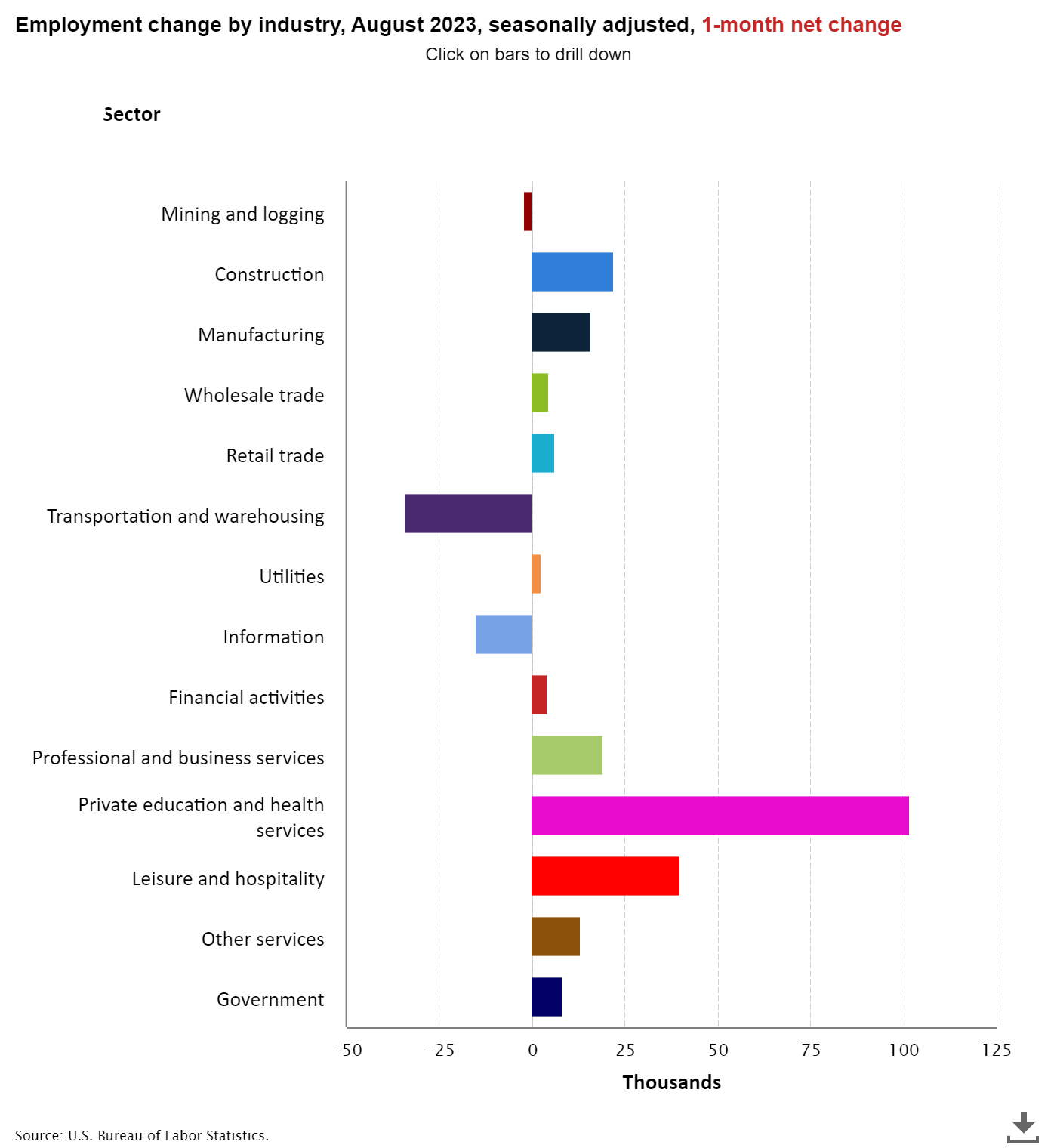
From BLSTotal nonfarm payroll employment increased by 187,000 in August, and the unemployment rate rose to 3.8 percent, the U.S. Bureau of Labor Statistics reported today. Employment continued to trend up in health care, leisure and hospitality, social assistance, and construction. Employment in transportation and warehousing declined.

The headline number beat estimates but had negative revisions in the previous months; we had a big jump in the labor force, which was the biggest reason the unemployment rate ticked up higher. We also had some one-time variables as one trucking company filing for bankruptcy, and the actors’ strike, which hit the data this month. Here is the breakdown of the jobs gained and lost:


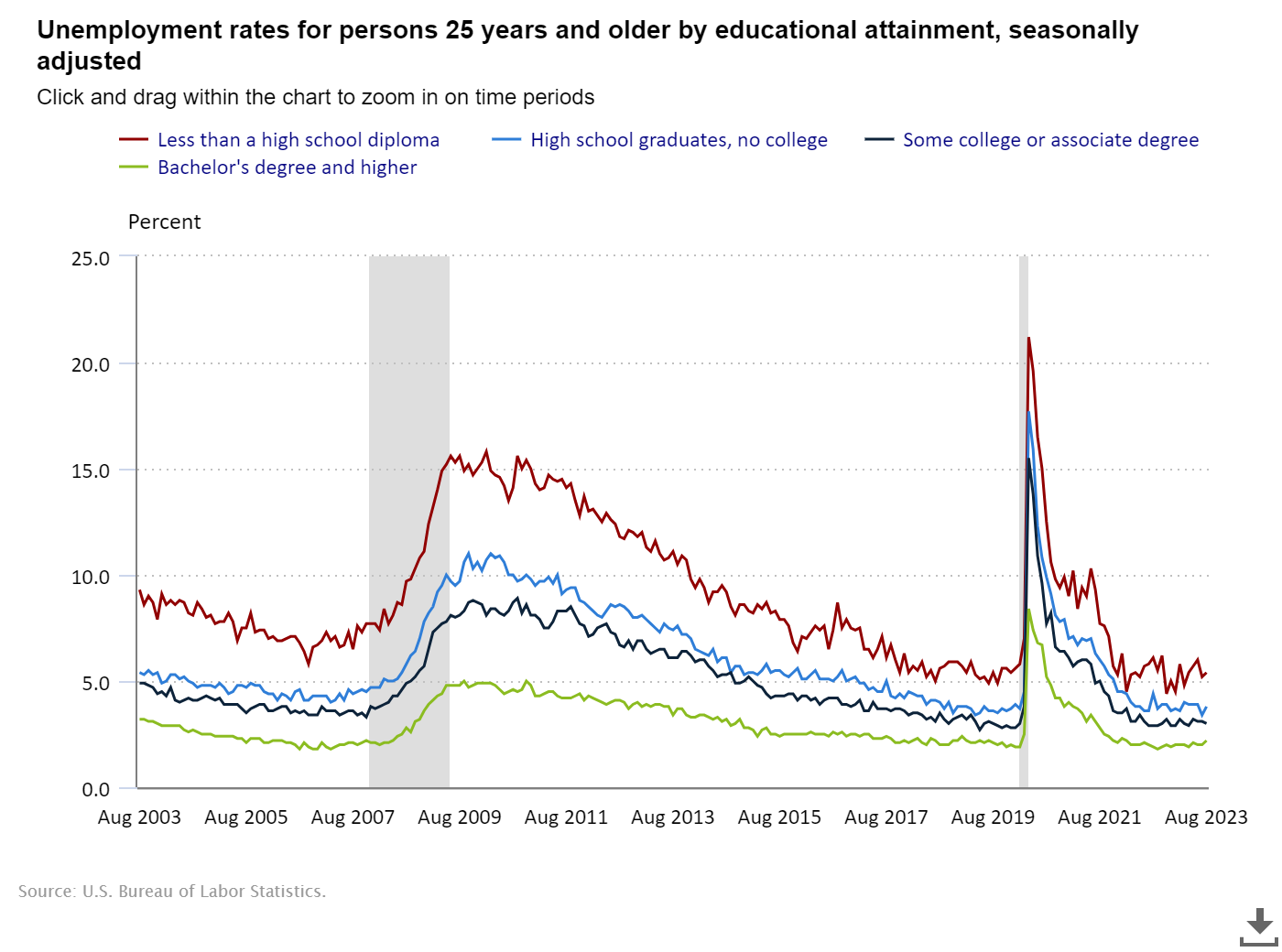
In this job report, the unemployment rate for education levels:

  • Less than a high school diploma: 5.4% from 5.2% 
  • High school graduate and no college: 3.8% from 3.4% 
  • Some college or associate degree: 3.0% 
  • Bachelor’s degree or higher: 2.2% from 2.0%. 

The key to the unemployment rate jumping was a big move in the labor force, especially from ages 55 plus in this report.

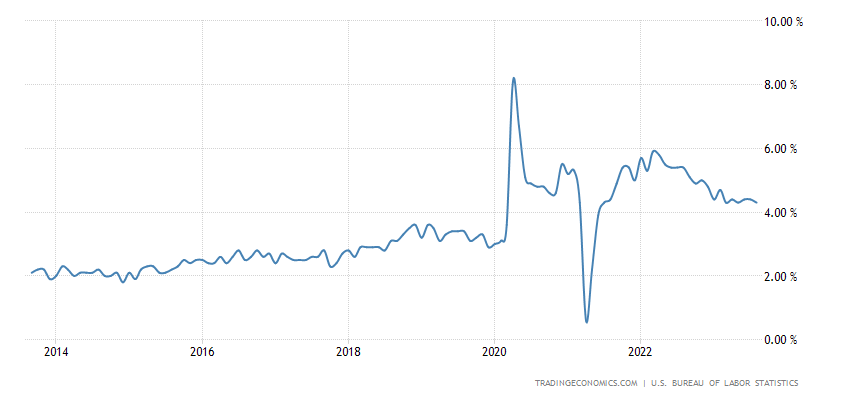
The Federal Reserve’s fear of wages spiraling out of control like we saw in the 1970s wasn’t a valid concern. As the growth rate of inflation fades, so should their fear on this topic. Wage growth has been slowing down since January of 2022. It might still be too hot for the Federal Reserve, but anyone who isn’t blind can see it’s not spiraling out of control. As the chart below shows, average hourly wage growth data is slowing down from a hot level.

Job openings

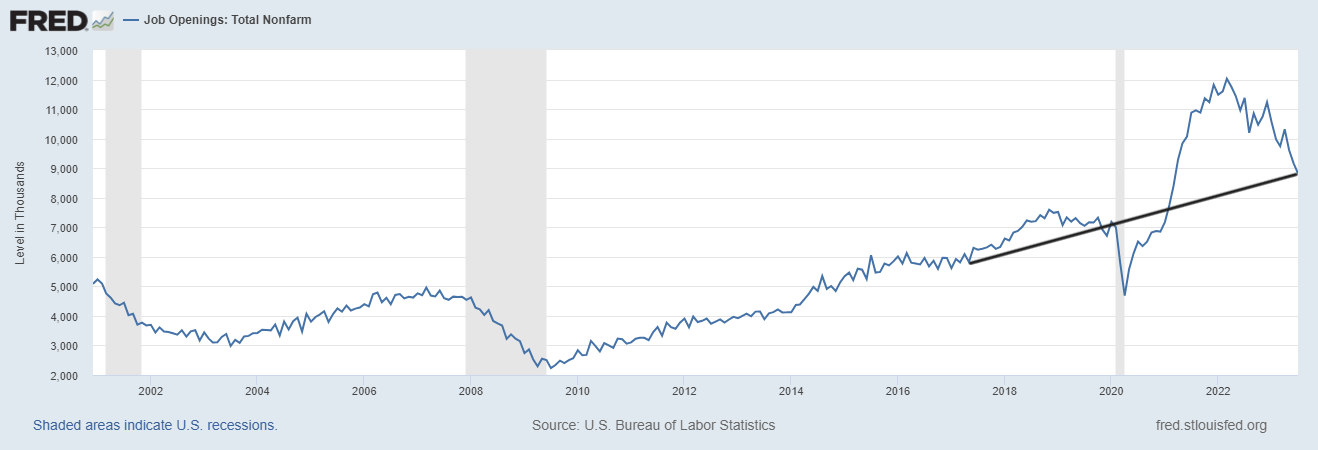
The job openings data is one of the Fed’s favorite labor market indicators: They use it to talk about how tight the labor market is. I believe the Fed members want to see the job openings data return toward 7 million so they have to be very pleased with the job openings falling below 9 million this week. As we can see in the chart below, the labor market isn’t as tight as it used to be.

Quits rate

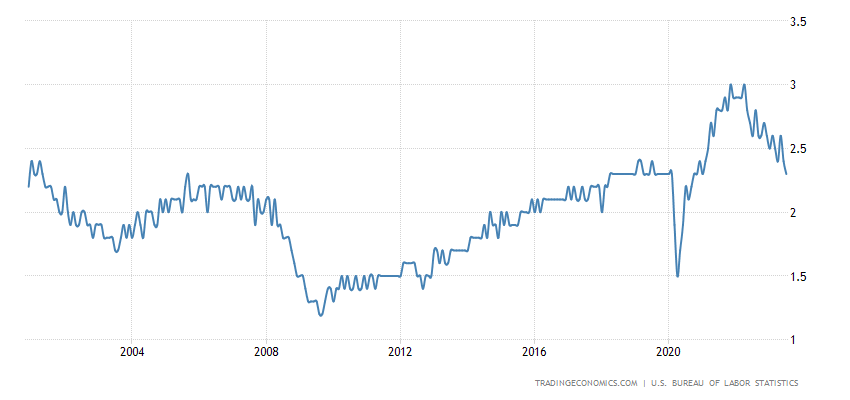
Another great data line for the Fed this week is that the quits rate has returned to pre-COVID-19 levels. With fewer people quitting for better-paying jobs, this makes the Fed much happier, especially in the lower-wage service sector, because people making more money on the low end isn’t something the Fed will tolerate. As Fed members have said recently, they want to see labor softness in the service sector.


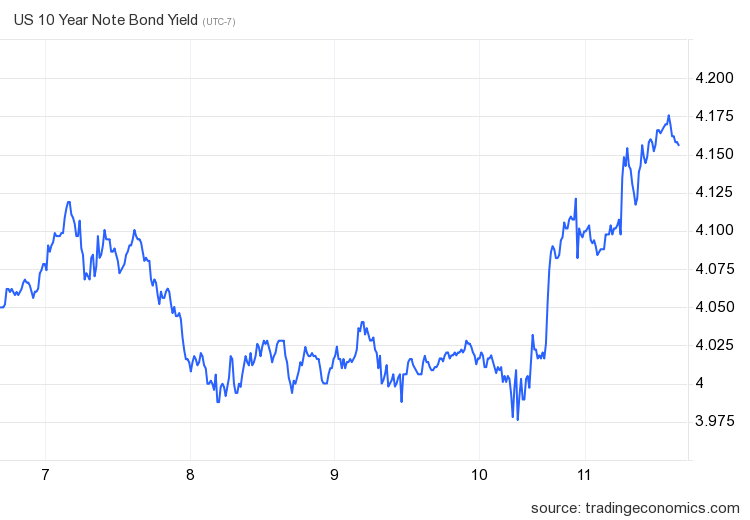
This was an epic jobs week because the Fed can say that they’re really making progress on attacking the labor market. Once you get a trend in labor data, it’s tough to reverse course quickly, especially as the Fed is in restrictive territory with their rates. Let’s not forget that the student loan debt payments are about to go online, which means less disposable income in the economy. The 10-year yield is slightly below my peak forecast for 2023 of 4.25%, sitting currently at 4.18%.


The things to focus on for the next 12 months are: the Fed is in restrictive territory with rates, student loan debt payments are about to start again and the labor market is getting less tight. When I say Fed members are happy about this week, it’s an understatement. They are very excited that the economy has a lot of variables that will attack the labor market.


Posted in
Sept. 2, 2023

Housing sector is showing signs of picking back up.


August 25, 2023, 11:40 am By 

In a hawkish tone, Jerome Powell said that Federal Reserve (Fed) officials are prepared to raise the federal funds rate further and hold it at high levels until they are confident that inflation is moving sustainably down to the 2% target. And that’s unclear at this point.

There are some sources of pressure on U.S. prices — among them is the housing market, Powell said Friday morning during an economic policy symposium in Jackson Hole, Wyoming. 

“So far this year, GDP [gross domestic product] growth has come in above expectations and above its longer-run trend, and recent readings on consumer spending have been especially robust,” Powell said. 

“In addition, after decelerating sharply over the past 18 months, the housing sector is showing signs of picking back up. Additional evidence of persistently above-trend growth could put further progress on inflation at risk and could warrant further tightening of monetary policy.”

Powell said that the effects of monetary policy became apparent soon after liftoff in the housing sector. Mortgage rates doubled in 2022, causing housing starts and sales to fall and house price growth to plummet. 

In fact, mortgage rates kept an upward trend in 2023, following the Fed’s moves to combat persistent inflation. On Friday, the 30-year fixed mortgage rate was 7.37% at Mortgage News Daily, the highest in over two decades. Economists see rates potentially reaching the 8% level

Regarding the housing services inflation, Powell said it lagged the monetary tightening. According to him, the main concern here is rents, which have only begun to slow down. “We will continue to watch the market rent data closely for a signal of the upside and downside risks to housing services inflation,” he said. 

Other components of inflation show different trends.

Core goods inflation has fallen sharply due to tighter monetary policy and the slow unwinding of supply and demand dislocations. Less sensitive to the Fed moves, nonhousing services, which account for over half of the core PCE and include items such as health care and transportation, have moved sideways since liftoff, Powell said. 

The labor market continues to rebalance, with improved supply and moderated demand. This rebalancing has eased wage pressures. The Fed expects the trend to continue, but evidence that the tightness in the labor market is no longer easing could also call for a monetary policy response, Powell said. 

Committed to the 2% target 

The core PCE inflation index, closely watched by the Fed officials, peaked at 5.4% on a 12-month basis in February 2022 and declined gradually to 4.3% in July 2023. 

The lower monthly readings in June and July of 2023 were welcome but only “the beginning of what it will take to build confidence that inflation is moving down sustainably toward our goal,” Powell said.

“We can’t yet know the extent to which these lower readings will continue or where underlying inflation will settle over coming quarters. Twelve-month core inflation is still elevated, and there is substantial further ground to cover to get back to price stability.”

The Fed, however, remains committed to the 2% inflation target, Powell said. It’s challenging to know when such a stance has been achieved in real-time, he remarked. 

Despite Powell seeing the current rate as restrictive to the economy, he can’t identify with certainty the neutral rate of interest – the rate at which monetary policy is neither stimulating nor restricting economic growth – which brings uncertainty about how high rates should be. In addition, it’s not clear the duration of the lags with which rate hikes affect economic activity and inflation. 

“As is often the case, we are navigating by the stars under cloudy skies,” Powell said. “We will proceed carefully as we decide whether to tighten further or, instead, to hold the policy rate constant and await further data.”  

Posted in
Aug. 30, 2023

Loan Estimate vs. Closing Disclosure in Vermont (2025) | What Buyers Need to Know

Understanding your mortgage paperwork is key to being a confident and informed Vermont homebuyer in 2025. Two critical documents—your Loan Estimate and Closing Disclosure—give you a clear picture of what your home loan will cost, from interest rate to closing fees.

What Is a Loan Estimate and Why Is It Important?

After applying for a mortgage, your lender is required to send you a Loan Estimate within three business days. This three-page document outlines the core terms of your loan, including your estimated interest rate, monthly mortgage payment, and expected closing costs.

It also includes key information like potential prepayment penalties, projected property taxes, and homeowners insurance costs. Review this document carefully—it’s your first official breakdown of what buying a home in Vermont will actually cost.

Loan disclosure paperwork

✅ Pro Tip: Use your Loan Estimate to compare offers from multiple lenders. Even a slight difference in the interest rate or lender fees can save you thousands over the life of your loan.

What Happens After You Receive a Loan Estimate?

If you’re satisfied with the terms, you’ll move forward by submitting supporting documents—typically your pay stubs, tax returns, bank statements, and ID. The lender will use this to verify your eligibility before issuing a full loan approval.

What Is a Closing Disclosure?

The Closing Disclosure is a five-page document your lender must give you at least three business days before closing on your home. It finalizes the costs outlined in your Loan Estimate—now with exact figures.

This document includes your final interest rate, exact monthly payment, full list of closing costs, and the total amount you’ll pay over the life of the loan. It also spells out whether your loan includes things like private mortgage insurance (PMI), prepayment penalties, or balloon payments.

Why the Closing Disclosure Matters in 2025

Loan terms can sometimes change between application and closing. It’s important to compare your Closing Disclosure with the original Loan Estimate. Differences should be minimal. If you spot anything unexpected or unclear, now’s the time to ask your lender before signing.

📌 Common discrepancies to watch for:

  • Higher-than-expected lender fees or third-party service costs
  • Changes in escrow amounts or prepaid taxes
  • Last-minute increases in interest rate (if not locked)

Be an Informed Homebuyer

The Loan Estimate and Closing Disclosure were introduced to protect buyers like you. They promote transparency and allow you to make confident financial decisions throughout the homebuying journey. Don’t rush the review process—especially with Vermont’s dynamic housing market in 2025.

Looking for more resources? Check out our full Ultimate Buyer’s Guide to navigate every step of the Vermont home loan process.

Posted in Home Buying Tips
Aug. 24, 2023

The Advantages of Retro Home Design


Reusing furniture, repurposing flooring and adopting sustainable materials and lighting that consume less energy, protect natural resources and lower emissions from the manufacture and delivery of new products is desirable. Natural materials like wood, rattan, clay and stone add warmth and lightness to home decor.

Wondering how to get into retro designing in an eco-friendly way? Try these tips:

  • Buy reclaimed. Reclaimed wood is an environmentally sound choice, given its versatility and growing popularity. It can be used for countertops, flooring and walls. It saves the time, money and energy that would be required to produce a similar and newer product.
  • Deconstruct your home. Before tearing down walls, see what you can salvage and reuse. Consider everything from light fixtures to flooring, tile, bricks, cabinets and molding.
  • Consider buying pre-owned materials — a cost-effective way to redo your home. Salvage shops often have high-quality cabinets in great condition.
  • Reface instead of replacing. Consider repainting cabinets. New doors and drawers can also give tired cabinets a whole new look.
  • Visit salvage yards and antique shops. Consignment shops are great places to visit for items such as doorknobs, light fixtures and even mantels.
  • Add skylights. If you don't like using lights in the middle of the day, install skylights to provide natural lighting. Strategically place them in the most frequently used spaces throughout the day, like the kitchen, sitting room or powder room.
    • Install shades to deflect sunlight when necessary. Skylights can help reduce your total energy consumption too.
  • Repurpose kitchen work tops, such as marble that has already been used.
  • Work with reclaimed hardwood panels. They are preseasoned, so they won't warp once placed. Scaffold boards are strong and reasonably simple to get, and they have a unique texture that suits both floors and display walls.
  • Consider cork, which has excellent acoustic and thermal characteristics, and when it is used as flooring, it is soft and springy, wipeable and waterproof.

Time to go shopping

Visit local flea markets, yard sales and antique stores to find one-of-a-kind pieces that have been redone with new upholstery or paint — ideal for a lived-in look at a fraction of the price of something new while supporting sustainability and eco-friendliness. The nonprofit Habitat for Humanity has stores that sell salvaged materials, furniture and appliances from remodeled or demolished homes, as well as items from store closeouts and surplus material from contractors, distributors and manufacturers.

The review site Yelp conducted research that shows that searches for reclaimed materials are up by 38%. Many home projects are currently being centered around getting back to the root of materials. Strip down lacquered cabinetry to expose the unfinished walnut underneath, or replace existing countertops with a marble slab with raw edges.

Using sustainable materials and lighting that consumes less energy looks good too. They bring a soft, modern aesthetic that is rooted in organic wood tones and clean, natural colors with the absence of excess, creating a positive impact on well-being and inspiring a sense of connection with nature.

Vintage or refurbished elements can add uniqueness and charm. With repurposed flooring, you can use pallets, copper pennies and recycled wood materials. Reusing furniture, repurposing flooring and adopting sustainable materials and lighting — current decor trends — stem from retro style reemerging in modern ways.

Posted in
Aug. 23, 2023

Where are mortgage rates headed?


August 13, 2023, 5:00 pm By 

Last week ended with a wild ride for mortgage rates. We anticipated the two inflation reports could help mortgage rates, however, we had a bad bond auction last Thursday, and the 10-year yield rose sharply. Weekly active inventory grew slowly again and purchase apps were down week to week again.

  • Weekly active listings rose by only 4,270
  • Mortgage rates went from 7.03% to 7.19%
  • Purchase apps were down 3% week to week

Mortgage rates and bond yields

Last week we started with lower bond yields as we anticipated inflation reports to continue the trend of slower year-over-year inflation data. This happened as expected, except we had a lousy bond auction, which meant too much debt supply came online with insufficient buyers. This pushed yields higher Thursday and Friday to move mortgage rates to 7.19%.


A valid case for higher mortgage rates in the short term is that we are simply going to be in an environment where we don’t have a lot of bond buyers versus the supply coming in, thus making it harder for mortgage rates to go lower. We saw an example of that last week.

For my 2023 forecast, my range on the 10-year yield has been between 3.21%-4.25%, emphasizing that the bond yields can go lower than 3.21% only if the labor market breaks. The labor market breaking to me is if jobless claims on a four-week moving average go over 323,000; currently, that data is 231,000. As the economy has stayed firm, bond yields are at a higher level of my range for 2023.

Weekly housing inventory

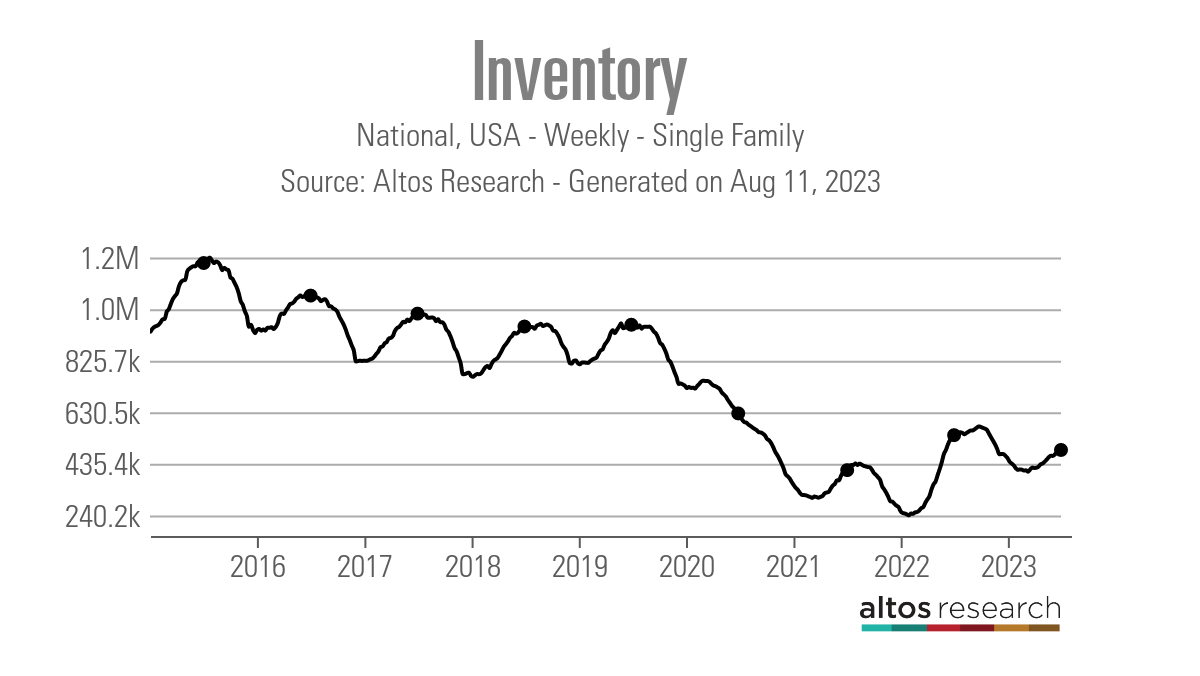
The painful housing inventory story of 2023 continues as we had yet another week of slow inventory growth. Last year when mortgage rates spiked higher, inventory growth was much faster, but we were also working from the lowest levels recorded in history in March of 2022. This year, it’s been a much different story. 

  • Weekly inventory change (August 4-August 11): Inventory rose from 487,870 to 492,140
  • Same week last year (August 5-August 12): Inventory rose from 543,898 to 550,175
  • The inventory bottom for 2022 was 240,194
  • The inventory peak for 2023 so far is 492,140
  • For context, active listings for this week in 2015 were 1,203,577


As we can see in the chart below, inventory growth has been so slow that active listings have been negative year over year for some time now. For those calling for a massive inventory spike since 2008, the last few years have not gone as planned.

New listings data has been trending at the lowest levels recorded in history for more than 12 months. However, even with higher mortgage rates in the last few months, we haven’t seen a new leg lower in this data line, which means we might be forming a workable bottom in 2023. As you can see in the chart below, 2023 has had a clear divergence versus 2021 and 2022 data, which were already at all-time lows before last year.

Here’s how new listings this week compare to the same week in past years:

  • 2023: 60,759
  • 2022: 73,384
  • 2021: 79,184


Purchase application data

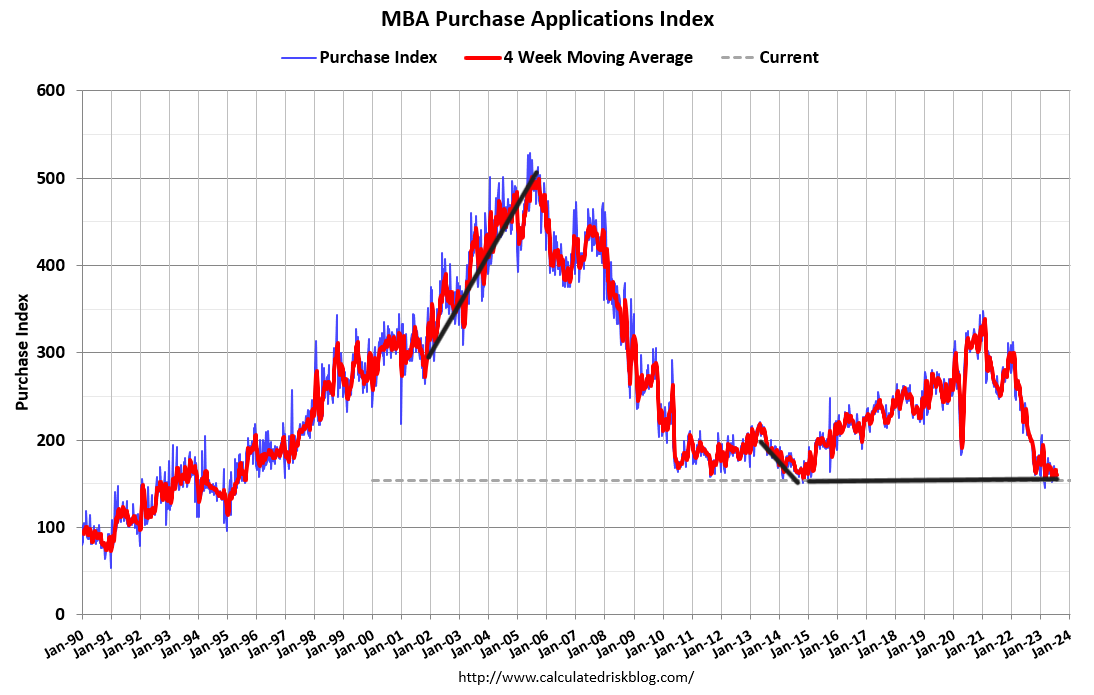
Purchase application data was down again by 3% last week, making the count year-to-date at 14 positive and 16 negative prints. If we start from Nov. 9, 2022, it’s been 21 positive prints versus 16 negative prints. Mortgage rates near or above 7% are simply too high to promote real growth in this data line, which is working from a historical bottom. 

So, when rates fall, moving the needle higher for purchase apps won’t take much. However, for now, rates this high have facilitated more negative week-to-week data than positive, leading to lower sales as this data line looks out 30-90 days. While we aren’t seeing sales collapse like last year, we aren’t growing sales meaningfully from the recent lows. 

The week ahead: Tons of economic data

This week, we have various economic data reports that can move mortgage rates and give us a sense of where the housing market is going. Retail sales and the Leading Economic Index are out this week. Also, we get two key data lines for housing this week: the homebuilders survey by NAHB/Wells Fargo and housing starts!

What I am looking for in housing data is what the builder survey indicates for the next six months. In last month’s report, we saw a slight decline in this data line. For this week, I want to see how mortgage rates react to the batch of new economic data. 


Posted in
Aug. 21, 2023

Expensive Mistakes To Avoid in Your Bathroom Remodel


Are you thinking about remodeling your bathroom? Whether you plan to do it yourself or hire someone to complete the work for you, it can be wise to educate yourself about the most common mistakes so you can make an effort to avoid potential long-term headaches.

Here are some of the most expensive mistakes people commonly make as well as how you can take measures to avoid them:

Opting for DIY when a contractor is a better choice

When remodeling your bathroom, the odds of running into unexpected issues are considerably high. Unless you're doing something for purely cosmetic reasons, it's worth speaking to a professional before you tear down any walls or make changes to the plumbing. While it might seem expensive to hire a professional, doing so will be far less costly than if you end up having to fix big mistakes down the road.

Not having a clear plan in place

Another issue many homeowners might run into is the lack of a clear plan. They have a vague idea of what they want the final project to look like, but they don't actively plan each step or focus on the specifics of the project. It's certainly worth being precise before you make too much progress and run into an obstacle that messes up an already loose plan.

Choosing the wrong materials to work with

You can spend a lot of money if you choose the wrong materials for your remodel. For example, several types of wood don't hold up to moisture in a bathroom and can become damaged over time.

Overlooking the small yet important details

Sometimes you might find yourself overlooking the minor details when it comes to remodeling your bathroom. But those little things can add up and become bigger, resulting in a major problem in the long run. When working on your design, ensure that you account for everything involved in the process, both big and small.

Experiencing fatigue near the end of the project

Just about everyone has started working on a project and then found themselves tired before the project is complete. You might find yourself feeling exhausted from work and eager to cut those last corners so you can finish the project as soon as possible. But this can prove to be a costly mistake when you find out in hindsight that some of those corners never should have been cut.

Posted in
Aug. 18, 2023

Housing starts tick back up in July in spite of headwinds


August 16, 2023, 2:33 pm By 

Housing starts picked up significantly in July to a seasonally adjusted annual rate of 1.452 million, according to the U.S. Census Bureau. That was up 3.9% from June and up 5.9% from a year ago. Meanwhile, permits for future construction eked a 0.1% gain from June but were 13% lower from a year ago.

The increase in housing starts came after an unexpected slump last month and beat expectations. The Census Bureau also adjusted June’s figures down to 1.398 million from 1.43 million.

Overall, single‐family housing starts in July came in at a rate of 983,000. This is 6.7% above the revised June figure of 921,000. The July rate for units in buildings with five units or more was 460,000. Single-family permits increased (+0.6%) to 930,000 in July while multifamily permits came in at 464,000.

Completed homes fell 11.8% from the prior month and were 5.4% below the July 2022 level. The pace of single-family home completions picked up from the prior month, boosted by gains in the Midwest and West.

Meanwhile, there are just over one million multifamily units under construction, a record.

Still, it’s a good, not great report, economists said. Housing starts have been down for 13 of the last 15 months on a year over year basis. And the NAHB/Wells Fargo builder confidence index also fell in August, the first decline in 2023.

Declines in the current pace of sales and the next six months pushed the index down, said George Ratiu, chief economist at Keeping Current Matters. 

In spite of the affordability challenges, homebuyers remain eager to buy. Developers and construction companies seem to “have come to terms with the affordability challenge and have been erecting smaller homes at more approachable prices this year,” said Ratiu. 

Though there are near-term and medium-term challenges with mortgage rates and waning affordability, the fundamentals still look good, economists said.

“Higher mortgage rates threaten affordability and builder supply-side challenges remain, but the housing market remains fundamentally underbuilt and existing homeowners aren’t moving,” said Odeta Kushi, deputy chief economist at First American. “While builders can’t make existing homeowners move, they can add more new homes to the housing stock.”

Completions were down in July, but that is about one year after permits and starts began to decline, leaving fewer homes in the pipeline and thus dampening completions, said Nicole Bachaud, an economist at Zillow.

“New construction remains a vital source of new inventory in this market, with many builders still offering incentives that allow for more buyers to find opportunities in the new homes market, so continuing to build is important to the overall health of this market,” she said.

There are other challenges for prospective homebuyers to overcome, said Travis Hodges, a managing director at insurance brokerage VIU by HUB. It’s become much more difficult to secure homeowners insurance in several markets, and rising costs are a big concern.

“With insurance premiums expected to be up 7% this year on average, finding coverage at a reasonable price is key for new home buyers to carry a mortgage,” Hodges said.

States like California and Florida, which are both prone to extreme weather events, are now facing issues of multiple carriers leaving the market. A similar situation might happen in Maui after catastrophic wildfires destroyed parts of the island. 
Posted in
Aug. 17, 2023

Best Way To Store and Display Books


Book lovers understand the need for sufficient storage space for their favorite books. You want a place to celebrate the knowledge within and access what you need when you need it. But books take up a lot of space and are more likely to accumulate than dissipate. The best way to store and display books depends on several factors, including the size of your collection, the available space and personal preferences. Here are some ways you can store and display your books.

Use bookshelves

Bookshelves are an excellent way to store and display books. You can choose from various materials, such as wood, metal or glass, and sizes that will fit your collection. Depending on your space, you can use built-in bookshelves or stand-alone shelves that match your room's decor.

Organize your books

Organize your books in a way that makes sense to you, such as by author, genre or topic. This will make it easier to find a particular book when you need it. A popular Netflix show about organizing chooses to display books by cover color, which can be visually appealing.

Keep them clean

Dust and debris can accumulate on book covers and pages, so keeping your books clean is essential. Use a soft cloth or brush to periodically remove dust from the covers and pages. A soft brush vacuum attachment can make the job go even faster. When you spring clean, remove all the books and dust and clean the shelves.

Avoid direct sunlight

Exposure to direct sunlight can cause book covers and dust jackets to fade or become yellow, so storing them away from windows is best. Use shades on your windows to prevent sun damage, or consider shelves with doors that can protect the books within.

Consider bookends

Bookends can be functional and decorative, helping to keep books upright and adding visual interest to a bookshelf. Choose bookends that match your design scheme and add visual appeal to your room overall.

Do you dream of creating a home library? Call us to see how we can help today.


Posted in
Aug. 17, 2023

Million-dollar homes nearing 10% of market as property prices rise


August 11, 2023, 8:20 pm By 

Nearly one in ten homes in the U.S. are worth at least $1 million dollars, close to all-time-high levels of June 2022, according to a new report from Redfin.

Just over 8% of homes are worth $1 million or more, not far off the high of 8.6% in June. This upswing in home prices comes on the heels of a major dip in February, when only 7.3% hit the $1 million price threshold. 

Home prices are increasing on a year-over-year basis after declining at the beginning of the year. The median U.S. home-sale price rose 3% year over year in July, the biggest increase since last November. Prices are rising faster for luxury homes, with the median sale price of up 4.6% year over year to $1.2 million in the second quarter.

Of course, elevated mortgage rates are symbolically handcuffing homeowners who want to cling to lower mortgage rates. As a result, inventory is scarce and homebuyers are competing for few available homes on the market. Steady demand is driving up prices, and affordability issues persist as buyers contend with high rates.

The number of homes actively for sale decreased by 6.4% compared to last year, according to the July Monthly Housing Market Trends Report from Realtor.com. 

“In most of the country, expensive properties that are in good condition and priced fairly are attracting buyers and in some cases bidding wars, mostly because for-sale signs are few and far between right now,” says Redfin Economics Research Lead Chen Zhao. “Recent economic signals that the U.S. may avoid a broad recession could cause high-end buyers to feel more confident in making a major purchase in the coming months. There may be more demand coming down the pipeline.” Hence, “there’s no rush to offload high-value homes.”

Meanwhile,, the share of homes worth seven figures has doubled from pre-pandemic levels, just over 4% of homes were valued at $1 million or more in June 2019. The share shot up when home prices skyrocketed in 2020 and 2021 as record-low mortgage rates and remote work drove Americans to buy homes.

Home prices in East coast metros are rising the fastest

Million-dollar homes are increasing quickly in some parts of New England. For example, 25.8% of homes in the Bridgeport, CT metro are worth at least $1 million, up from 23.1% a year ago, the biggest increase among metros in Redfin’s analysis. Boston, where the share increased from 20.3% to 21.5%, was second, followed by Newark, NJ (8.7% to 9.7%).

Nationally, the number of homes worth $1 million or more rose year over year in 55 of the 99 most populous U.S. metros. However, the uptick remains small, less than one percentage point, in almost all of those.

The share of seven-figure homes is falling in West Coast metros 

Expensive coastal metros are losing million-dollar homes fastest. Seattle scored the biggest drop in share of expensive houses, from 39.3% to 33%. Oakland, CA (55.1% to 49%) and Oxnard, CA (40.2% to 34.5%) placed second and third, respectively.

Los Angeles, San Diego, San Jose, San Francisco, Anaheim, New York and Washington, D.C. are also among the metros that saw drops in the number of million-dollar homes.

Still, California has the highest share of million-dollar-plus homes in the country, by far.

Million-dollar homes are rare in some parts of Texas and the Rust Belt

Few million-dollar homes can be found in several inexpensive metros, including parts of Texas and upstate New York.

For example, the share of homes worth $1 million or more is 0.5% or lower in Omaha, NE; Dayton, OH; McAllen, TX; El Paso, TX; Akron, OH; Detroit; Buffalo, NY; Elgin, IL and Rochester, NY

Posted in