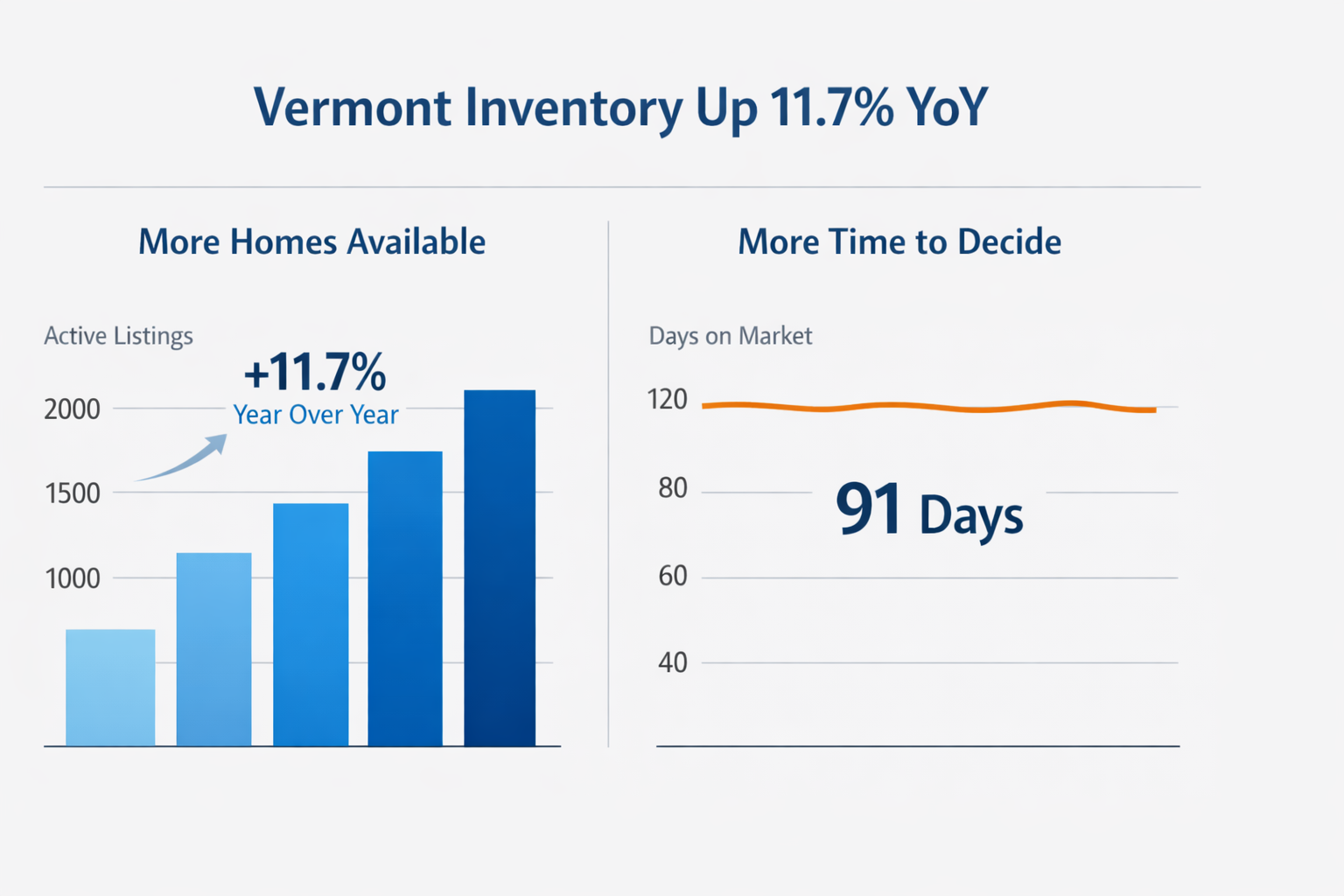
Vermont's spring housing market is quietly giving buyers the most negotiating room since before the pandemic — more inventory, longer days on market, and a sale-to-list ratio that's finally moved off the ceiling. While national headlines are calling spring 2026 a deep freeze, the Vermont data tells a different story: the window is open, and the buyers who show up prepared are the ones who'll use it.
If You Only Do 3 Things- Check the Vermont inventory picture before you assume it's still a seller's market — active listings are up nearly 12% year over year and homes are sitting an average of 91 days.
- Run your payment math at 6.22%, not at 3% — that's the number that determines your budget ceiling today, and it's more manageable than most fence-sitters expect.
- Talk to a local broker before spring competition returns — buyers who move in late March and April are negotiating; buyers who wait for certainty are competing.

What Changed — And the One Number That Matters
The national housing narrative this spring is grim. Oil prices, a Middle East conflict, a Fed that's holding rates steady, and buyers who can't shake their economic anxiety. U.S. News is calling it "stuck in the deep freeze." That framing isn't wrong — nationally. But Vermont isn't a national market.
Here's what the data tells us. Vermont entered spring 2026 with more homes for sale, longer selling timelines, and sellers who are — for the first time in years — negotiating. That's a different market than the one most buyers think they're walking into.
The Data — Two Numbers, Translated
year over year (Jan 2026)
statewide (Jan 2026)
Vermont (Jan 2026)
Let's run the numbers on rate. At 6.22% on a 30-year fixed — Freddie Mac's weekly average as of March 19 — a $350,000 loan carries a principal and interest payment of roughly $2,150 per month. That's not comfortable for everyone. But it's also not 8%, and it's not moving dramatically in either direction in the near term. The Fed held its benchmark rate at 3.50%–3.75% this week. Math doesn't care about what we hoped rates would be. It only cares about what they are.
So What Does That Mean for Vermont?
_standing_at_the_front_door_of_a_Vermont.png)
Here's the scenario where this matters most. If you've been watching the Vermont market for 12 to 18 months, waiting for a clear signal, 91 days on market is that signal. Sellers aren't desperate — Vermont prices are holding — but they're realistic. That's a different conversation than 2022, when you were lucky to get a showing.
The tradeoff is simple. Move now while inventory is up and competition is low, or wait and risk moving when the spring absorption cycle tightens things back up. Vermont inventory climbs in spring and pulls back by fall. That pattern hasn't changed. The window is real.
Bottom Line
If you're buying: Vermont is giving you the most room to negotiate it has in years. More listings, longer days on market, and sellers accepting 96.3 cents on the dollar. Get pre-approved, get specific about your target towns, and engage now — before the spring cycle compresses inventory and competition rises again.
If you're selling: Pricing to today's market isn't pessimism — it's math. Homes priced at the 96.3% sale-to-list reality are moving. Homes priced for 2022 are sitting, and 91 days on market is a long time to carry a property. The buyers are out there. They're just picky, deliberate, and well-informed.
For both: The national noise is real, but Vermont isn't national. Here's what the data tells us — local inventory, local days on market, and local sale prices are the numbers that change your decision. Everything else is background.

What to Do Next
The spring buying season is already underway in Vermont. If you want to understand exactly how current inventory, days on market, and pricing look in your target town — not statewide, not nationally — Tony Walton and the team at New England Landmark Realty (NELR) can run that for you. No obligation. Just numbers.
Talk to New England Landmark Realty (NELR)
Office: (802) 253-4711 | Toll-free: (866) 324-2427
Tony Walton, Principal Broker: (802) 233-4107
Where to Go Next
Sources
Redfin Data Center — Vermont Housing Market, January 2026: redfin.com/state/Vermont/housing-market
Freddie Mac Primary Mortgage Market Survey (PMMS) — March 19, 2026: freddiemac.com/pmms
Federal Reserve FOMC Statement — March 18, 2026: federalreserve.gov

:format(webp):quality(80)/u.realgeeks.media/rgtemplate/Market-Report-2.png)